Game page
The Chameleon
One player does not know the secret word and has to talk their way through a round without being caught. Fifteen minutes, an argument every time, and a very low floor of three players.
By Scooter M. · Published · Last updated
How this page is funded: the buy links below are affiliate links. If you buy through one, we earn a commission at no extra cost to you. It does not change the order of the picks or what we say about them. Full disclosure.
Games we claim to have play-tested: 0. Every gift guide in this category implies a shelf of played games behind it. We do not have one, and we would rather say so. What we do instead is on this page: the publisher’s own player count, playing time and age band for every pick, cited to the publisher; a live price rather than a remembered one; and a plain answer on who should skip each game.
The short answer
The Chameleon is the social deduction game to buy for a group of three to eight adults who like arguing. Big Potato states 3-8 players, 15 minutes and 14+. Everyone but one player sees the secret word, each person says one word about it, and the table votes on who was faking. If the group includes under-14s, buy Codenames instead.
What it actually is
A topic card goes down - a grid of sixteen related words. Everyone rolls or draws a code that points at one square, so the whole table knows the secret word. Everyone, that is, except the Chameleon, who has the same card in front of them and no idea which word the rest of you are looking at.
Then each player, in turn, says exactly one word related to the secret word. If you say something too obvious, the Chameleon works out the answer from your clue. If you say something too vague, the table decides you are the Chameleon. The Chameleon has to invent a word that sounds like it belongs. Then everybody points at who they think it was.
Big Potato’s own summary of the rules is three steps: everyone apart from the Chameleon sees the secret topic, each player says one word related to it including the Chameleon who is bluffing, and then players point at who they think the Chameleon is. The publisher lists 40 topic cards, 16 code cards and 2 dice in the box.
| Figure | Value | Source |
|---|---|---|
| Players | 3-8 | Big Potato Games, published product page |
| Age | 14+ | Big Potato Games, published product page |
| Length | 15 min | Big Potato Games, published product page |
| Contents | 40 topic cards, 16 code cards, 2 dice | Big Potato Games, published product page |
Who it is for
- Best for a group that likes accusing each other. The fun is the argument before the vote, not the puzzle.
- Best bluffing game that works at three. A floor of three is genuinely unusual for social deduction, and the publisher prints a special rule for it: at 3 players the Chameleon gets two guesses if caught.
- Best fifteen-minute party game for adults. It fits before dinner rather than instead of it.
- Best for quieter players. One word per person per round is a format that stops the loudest person taking over.
Why one word is the whole design
Most party games ask you to perform. This one asks you to say a single word and then defend it, which is a much lower barrier and a much higher tension. You have to pick a word that proves you know the answer to everybody except the one person who would learn the answer from it - and you have about four seconds to do it.
That is why it produces an argument every time, and why the argument is the point. Nobody is ever quite sure, the vote is usually wrong at least once an evening, and the person who gets away with it is unbearable for the rest of the night. If that sounds like your group it is an easy recommendation; if it sounds exhausting, it is not.
What is good about it
- Fifteen stated minutes, so it slots into an evening rather than owning it
- Explains in about a minute - there is one rule and one thing you have to do
- A stated floor of three, with a published rule for playing at that count
- Up to eight players, which covers most rooms without a second box
- Bluffing gives people who dislike quizzes and arithmetic something to be good at
- Small box, so it travels and stores without ceremony
What is not
- Big Potato rates it 14+, which rules it out as a family-with-children gift in a way Codenames is not
- Being the Chameleon is far more fun than not being the Chameleon, and most rounds you are not
- Groups who dislike confrontation will not enjoy being voted on, and will say so
- The publisher advertises 800 secret words but lists 40 topic cards in the box, and does not explain how those two figures relate - so judge the content by the card count
- A round is over quickly, which means the box lives or dies on whether the table wants to go again
Who should skip it
A family with under-14s. That is Big Potato’s own age floor, and the bluffing genuinely is harder for younger players - a child who cannot keep a straight face is caught every round, which stops being funny for them quickly. Our teens page has the games that do work at that age.
Three people who will only ever be three. It is playable at three and better at five or six. If three is the permanent table, our three-player page ranks games built for it rather than games that reach down to it.
Anyone who wants a game rather than a conversation. There is almost nothing mechanical here. If the recipient likes a board, pieces and a plan, this will read as thin - try our strategy picks.
How it compares to the other word and deduction games we cover
Against Codenames (Czech Games Edition: 4-8 players, 10+, 15 minutes), The Chameleon is the one with a liar in it and Codenames is the one you can give a family. Codenames also starts at a lower age and needs four rather than three.
Against Just One (Repos Production: 3-7 players, 8+, 20 minutes), which is the cooperative version of the same one-word idea, The Chameleon is adversarial and Just One is the game where the table is on the same side. For a mixed group with children, Just One every time.
Against Skull (Space Cowboys: 3-6 players, 10+, 30 minutes), the other bluffing game we cover, Skull is quieter and more tense and The Chameleon is louder and funnier. Skull also has no words at all in it, which matters at a mixed-language table.
What it costs
It sits in the middle of the party-game range - more than a tin of cards, less than a full-size box with a board. We never print a remembered price anywhere on this site: the button above shows a live figure when we hold one and says so plainly when we do not. Our party picks show what else that money buys.
What we would buy for this
Chosen from the same registry as our roundups, on the publisher's own figures and a live price.
The Chameleon
Big Potato Games · A group that enjoys accusing each other of things
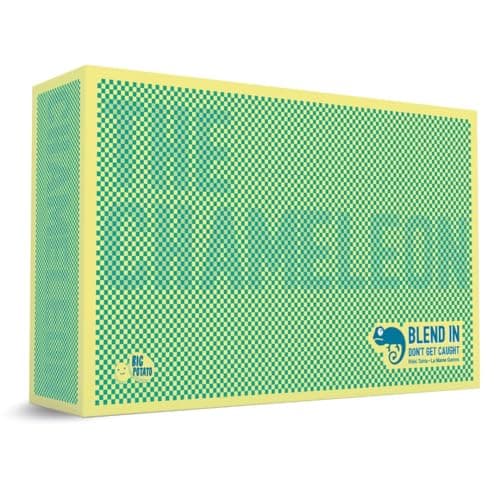
One player does not know the secret word and has to bluff through a round of one-word clues without being caught. Short, sharp, and it produces an argument every single time - which is the point of it.
#ad Price as of October 18, 2026, from Amazon. Prices change. How we make money.
What it actually is
A social deduction game. Everyone gives a one-word clue about a secret word; one player is faking it, and the table votes on who.
What the publisher states
| Figure | Value | Source |
|---|---|---|
| Players | 3-8 | Big Potato Games, published product page |
| Age | 14+ | Big Potato Games, published product page |
| Length | 15 min | Big Potato Games, published product page |
Read from the publisher’s own page. Where a publisher does not state a figure, there is no row for it here.
What is good about it
- Fifteen minutes, so it fits before dinner rather than instead of it
- Bluffing gives quieter players something to do that is not arithmetic
- A floor of three players is unusually low for a deduction game
What is not
- Rated 14+ by the publisher, so it is not a young-family pick
- Being the chameleon is much more fun than not being the chameleon
- Groups who dislike confrontation will not enjoy the voting
Who should skip it
Skip it for a family with under-14s - that is Big Potato's own age floor, and the bluffing genuinely is harder for younger players.
How it scored as a gift
- Easy to explain9.3
- Works for non-gamers9.0
- Group size range8.4
- Repeat plays8.0
- Feels like a gift8.4
Gift fit 8.5 / 10. That is our editorial judgment of how safe and well-aimed this is as a present, read off the published specifications - not a verdict on how good the game is, and not a test result. It is deliberately not marked up as a rating in this page’s structured data. How we pick.
How these were picked
We have not played these games and we do not pretend to have. What we did was read each publisher’s own page, take their stated player count, playing time and age band, check that every pick genuinely fits the constraint in this page’s title, confirm it is still being sold, and pull a live price rather than a remembered one. Every figure here names the publisher it came from, so you can check it yourself in about a minute.
How we pick sets out the full method, including what would change a ranking.
Questions people ask
+−How many players do you need for The Chameleon?
Big Potato states 3-8 players. At three the publisher prints a special rule - the Chameleon gets two guesses if caught - which is how the game stays balanced at the bottom of its range. Five or six is where it is at its best.
+−What age is The Chameleon for?
The publisher’s product header says 14+. Confusingly, the same page elsewhere says the clue-reading and bluffing suit ages 12 and up, without explaining the difference. We go with the stated 14+ and suggest you treat 12 and 13 as a judgment call about the particular child.
+−How long does a game of The Chameleon take?
Big Potato states 15 minutes, and the publisher’s own FAQ says a full game usually lasts around 15 to 20. A single round is a couple of minutes, so most groups play several.
+−Is The Chameleon like Codenames?
Only in that both are word games played in a group. Codenames is two teams giving clues to each other and is rated 10+; The Chameleon has one hidden player bluffing against everyone else and is rated 14+. Buy Codenames for a family, The Chameleon for a group of adults.
+−Is The Chameleon a good gift?
For a group of adults who already enjoy party games, yes - it is short, it explains in a minute and it produces the kind of evening people retell. It is a poor gift for a household with children, for anyone who hates being accused of things, and for somebody who wants a game with pieces to move.