Head to head
Carcassonne vs Ticket to Ride
The two games most often bought as somebody's first proper board game. They are closer than almost any other pair we cover, so the deciding factors are small and specific.
By Scooter M. · Published · Last updated
How this page is funded: the buy links below are affiliate links. If you buy through one, we earn a commission at no extra cost to you. It does not change the order of the picks or what we say about them. Full disclosure.
Games we claim to have play-tested: 0. Every gift guide in this category implies a shelf of played games behind it. We do not have one, and we would rather say so. What we do instead is on this page: the publisher’s own player count, playing time and age band for every pick, cited to the publisher; a live price rather than a remembered one; and a plain answer on who should skip each game.
The short answer
Buy Ticket to Ride if it has to look like a present and the youngest player is eight or older - Days of Wonder states 2-5 players, ages 8+, 30-60 minutes. Buy Carcassonne if there is a seven-year-old at the table or you want the shorter, cheaper game - Z-Man Games states 2-5 players, ages 7+, 30-45 minutes. Both are correct answers; almost nobody regrets either.
Side by side
| Carcassonne | Ticket to Ride | |
|---|---|---|
| Players | 2-5 | 2-5 |
| Playing time | 30-45 min | 30-60 min |
| Age | 7+ | 8+ |
| Publisher | Z-Man Games | Days of Wonder |
| What you do | Draw a tile, place it, sometimes claim it | Collect matching cards, claim a route |
| What is in the box | Tiles and small wooden figures | A large map, cards and 240 plastic trains |
| Reading required | None | City names on the map |
Where each one wins
Ticket to Ride wins as an object. It is a big box with a full-size map and a heap of little plastic trains, and it looks like a proper present when it is unwrapped. It also has the cleanest one-sentence goal of any game we cover: connect the cities on your ticket before anybody blocks the route. That is why it is our most-recommended board game for a household that owns none.
Carcassonne wins on age, length and price. Z-Man’s stated floor is 7 against Days of Wonder’s 8, which sounds trivial and is not when the child in question is seven. There is no reading at all - you place a tile so the roads and fields line up - and it is a smaller, cheaper box that finishes in well under an hour.
How they actually differ at the table
Carcassonne grows a shared picture: everybody adds to the same sprawling map, so the board at the end is something the table built together even though only one person won. Turns are short, and a player who is losing is still adding to the same landscape.
Ticket to Ride keeps your plan private until you commit to it. You are collecting cards for a route somebody else might take first, and the moment they take it is the emotional center of the game. Some tables love that; others find it the one sour note. It is the single thing to weigh before buying, and it is covered further in the five ways a board game gift goes wrong.
Pick Carcassonne if...
- The youngest player is seven
- Nobody at the table wants to read anything
- You want the shorter game and the smaller spend
- Somebody takes it badly when a plan is blocked
Pick Ticket to Ride if...
- The gift has to look substantial when it is opened
- Everyone is eight or older
- You want the version of a board game that people picture when they say the words
- The household will play it with visitors as well as with each other
The honest answer if you can only buy one
Ticket to Ride, unless a seven-year-old is involved. It carries an evening better with guests, it explains itself faster to somebody who has never played anything, and the box does more work as a present. Carcassonne is the better game to own second, and the two do not overlap - one is a shared picture, the other is a race.
Both games are on our list for people who do not play board games, and both sit in the same price band, covered on our under-$50 page.
What we would buy for this
Chosen from the same registry as our roundups, on the publisher's own figures and a live price.
Carcassonne
Z-Man Games · A family with a genuinely mixed age range
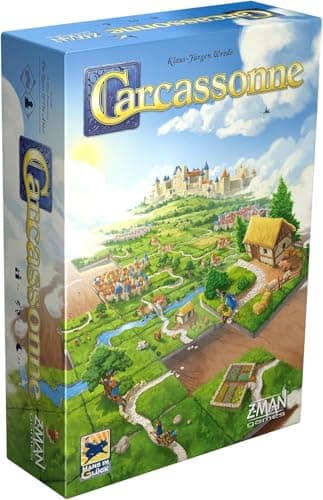
You draw a tile, you put it down so the roads and fields line up, and sometimes you put a little wooden person on it. Z-Man's stated age floor is 7, the lowest of any full board game here, and it plays two to five.
#ad Price as of October 21, 2026, from Amazon. Prices change. How we make money.
What it actually is
A tile-laying game. The board is built as you play, one square tile at a time, and you claim the roads, cities and fields you help complete.
What the publisher states
| Figure | Value | Source |
|---|---|---|
| Players | 2-5 | Z-Man Games, published product page |
| Age | 7+ | Z-Man Games, published product page |
| Playing time | 30-45 min | Z-Man Games, published product page |
Read from the publisher’s own page. Where a publisher does not state a figure, there is no row for it here.
What is good about it
- An age floor of 7 with no reading required at all
- Genuinely playable at two, which most family games are not
- No two games start the same, because the board is different every time
What is not
- Field scoring at the end confuses almost everybody the first time
- A run of unhelpful tiles feels like bad luck rather than a decision
- The little wooden figures are exactly the size a toddler will eat
Who should skip it
Skip it for a group of six or more, and skip it for anyone who wants the scoring to be obvious - the farms rule is the one everybody argues about.
How it scored as a gift
- Easy to explain8.6
- Works for non-gamers9.0
- Group size range8.6
- Repeat plays9.2
- Feels like a gift8.8
Gift fit 8.8 / 10. That is our editorial judgment of how safe and well-aimed this is as a present, read off the published specifications - not a verdict on how good the game is, and not a test result. It is deliberately not marked up as a rating in this page’s structured data. How we pick.
Ticket to Ride
Days of Wonder · A household that owns no board games at all
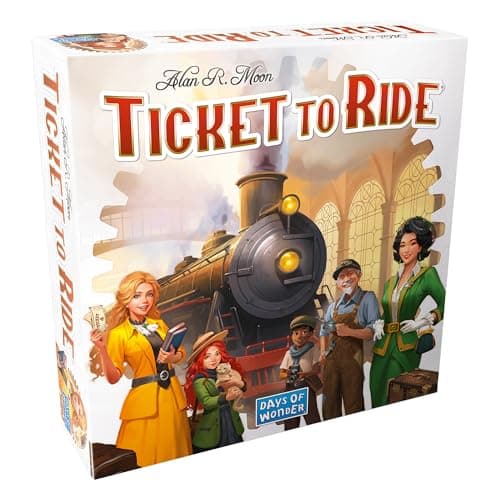
The default answer to 'we want a proper board game and nobody here plays board games'. You collect colored cards and use them to claim railway routes across a map of the United States. That is the whole idea, and it is enough.
#ad Price as of October 21, 2026, from Amazon. Prices change. How we make money.
What it actually is
A route-building game. You gather sets of matching cards and spend them to place little plastic trains along the lines between cities.
What the publisher states
| Figure | Value | Source |
|---|---|---|
| Players | 2-5 | Days of Wonder, published game page |
| Age | 8+ | Days of Wonder, published game page |
| Playing time | 30-60 min | Days of Wonder, published game page |
Read from the publisher’s own page. Where a publisher does not state a figure, there is no row for it here.
What is good about it
- One of the shortest explanations of any full-size board game: collect cards, claim routes
- Two to five players from one box, and it is decent at every count in that range
- The map and the trains do a lot of the work of making it feel like an occasion
What is not
- Someone can take the route you needed, and new players take that badly
- At the 60-minute end it outstays its welcome with restless players
- The plastic trains are small enough to lose under a sofa
Who should skip it
Skip it for a group of six or more - the box stops at five - and skip it for someone who wants a fifteen-minute game.
How it scored as a gift
- Easy to explain9.0
- Works for non-gamers9.6
- Group size range8.6
- Repeat plays9.0
- Feels like a gift9.8
Gift fit 9.5 / 10. That is our editorial judgment of how safe and well-aimed this is as a present, read off the published specifications - not a verdict on how good the game is, and not a test result. It is deliberately not marked up as a rating in this page’s structured data. How we pick.
How these were picked
We have not played these games and we do not pretend to have. What we did was read each publisher’s own page, take their stated player count, playing time and age band, check that every pick genuinely fits the constraint in this page’s title, confirm it is still being sold, and pull a live price rather than a remembered one. Every figure here names the publisher it came from, so you can check it yourself in about a minute.
How we pick sets out the full method, including what would change a ranking.
Questions people ask
+−Is Carcassonne or Ticket to Ride better for beginners?
Ticket to Ride, marginally - the goal is one sentence and the map does the explaining. Carcassonne is easier for younger players, because Z-Man states 7+ against Days of Wonder’s 8+ and there is no reading in it at all.
+−Which is shorter, Carcassonne or Ticket to Ride?
Carcassonne. Z-Man Games states 30-45 minutes; Days of Wonder states 30-60 minutes for Ticket to Ride. Both are among the shorter full-size board games we cover.
+−Do both play with two players?
Yes - both publishers state 2-5 players. Neither was designed for two specifically, and a game built for exactly two will be better if the household is a couple.
+−Which is better for a family with young children?
Carcassonne, on the publishers’ own numbers: Z-Man rates it 7+ with no reading required, against 8+ for Ticket to Ride. Z-Man also publishes My First Carcassonne, rated 4+, for younger children still.