Game page
Hive
Chess played with heavy tiles and no board at all: the pieces themselves become the board as you play. It is the most durable game on this site and the one most likely to live in a bag.
By Scooter M. · Published · Last updated
How this page is funded: the buy links below are affiliate links. If you buy through one, we earn a commission at no extra cost to you. It does not change the order of the picks or what we say about them. Full disclosure.
Games we claim to have play-tested: 0. Every gift guide in this category implies a shelf of played games behind it. We do not have one, and we would rather say so. What we do instead is on this page: the publisher’s own player count, playing time and age band for every pick, cited to the publisher; a live price rather than a remembered one; and a plain answer on who should skip each game.
The short answer
Hive is an abstract game for exactly two people. Gen42 states 2 players, ages 9+, 20 minutes. In the publisher’s own words, “There is no board! The pieces are added to the playing area thus creating the board.” You win by surrounding your opponent’s Queen Bee.
What it actually is
Each player has a set of hexagonal insect tiles. On your turn you either add a tile from your hand to the hive or move one that is already there. The hive grows outward from the first tile placed, and the shape it makes is the board.
The pieces move differently from each other. Gen42 describes soldier ants battling for control of the hive, beetles climbing for dominance, spiders positioning themselves and grasshoppers jumping in to attack. Learning what each insect does is the entire rulebook.
The win condition is stated plainly by the publisher: surround your opponent’s Queen Bee with pieces of either color, and the first player to do that wins. Pieces of your own color count, which is why a careless move can help your opponent finish the job for you.
| Figure | Value | Source |
|---|---|---|
| Players | 2 | Gen42 Games, published product page |
| Age | 9+ | Gen42 Games, published product page |
| Game duration | 20 mins | Gen42 Games, published product page |
The no-board thing is not a gimmick
It is the practical reason to own this rather than a different abstract game. There is no board to lose, no cards to bend, no paper to run out of, and nothing in the box that is damaged by being carried in a rucksack for a year.
That makes Hive the travel game we would actually take on a trip, as distinct from the ones sold as travel editions - and it is one of the few games where a bag, a table and twenty minutes is the entire requirement. Our travel games page has the rest of that shelf, most of which is cards.
What is good about it
- Nothing to lose or tear - no board, no cards, no scoresheets, just tiles in a bag
- Twenty minutes on the publisher’s clock for a genuinely deep abstract game
- Sets up in seconds: the first tile goes down and the game has started
- The tiles are heavy and pleasant to handle, which is a real part of why it presents well as a gift
- A stated floor of 9, which is low for a game with this much thinking in it
What is not
- Pure abstract strategy - there is no theme to enjoy if the puzzle itself does not land
- No luck at all, so a stronger player wins every single time, which ends some households’ interest in it fast
- Two players only, with no variant in the box
- The first few games are spent learning what each insect does rather than playing well
- It costs more than most small games, because the components are the product
The first three games are the learning curve
Hive has a shape that catches people out. The rules take two minutes - add a tile or move a tile, and surround the queen - but each insect moves differently, and until you know all of them you are playing without seeing half the board.
That is worth knowing if you are giving it to somebody who does not play games often. The first game will feel like a demonstration, the second like a game, and the third is where it becomes interesting. It is not a box to unwrap and play once at a family gathering; it is a box for two people who will come back to it.
Who should skip it
Anyone who does not enjoy chess-like thinking. Hive is the same kind of puzzle in a different shape. If that has never appealed, nothing else in this box will change it.
Households that are usually three or more. Gen42 states 2, and there is no variant. This is a strictly two-player purchase.
Players who want to see progress. There is no score, no collection and nothing building up - you are either surrounding the queen or you are not. Splendor Duel or Patchwork give a two-player table something to accumulate instead.
How it compares to the other two-player games we cover
Against Patchwork (Lookout Games: 2 players, 8+, approx. 30 minutes), Hive is the confrontational one. Patchwork is two people solving parallel puzzles; Hive is two people trying to trap each other. Patchwork also has the lower stated age.
Against Jaipur (Space Cowboys: 2 players, 10+, 30 minutes), Jaipur has luck in it and Hive does not - which is exactly the reason to choose one over the other. Our Jaipur review covers that side.
Against a chess set, which is the real competition: Hive is shorter, has no notation to learn, and a nine-year-old can be taught it in five minutes. It is also the one that fits in a coat pocket.
What it costs
Hive is one of the more expensive small games we cover, and the money is visibly in the tiles - they are thick, heavy and built to survive. We never print a remembered price anywhere on this site: the button above shows a live figure when we hold one and says so plainly when we do not. Our picks under $50 put it in context.
What we would buy for this
Chosen from the same registry as our roundups, on the publisher's own figures and a live price.
Hive
Gen42 Games · Someone who likes chess but is tired of chess
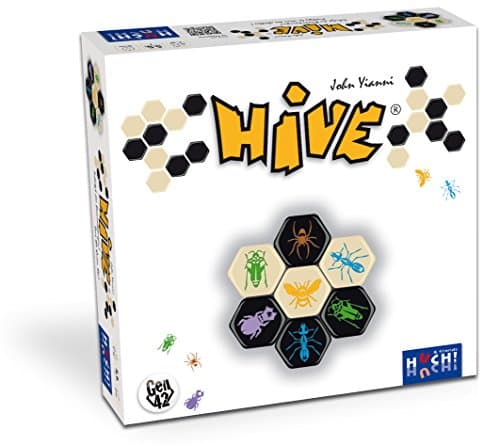
Chess played with heavy bakelite tiles and no board at all - the pieces themselves are the board. Gen42 states 2 players, ages 9+, 20 minutes. It is the most durable game on this site.
#ad Price as of October 15, 2026, from Amazon. Prices change. How we make money.
What it actually is
An abstract two-player game. Each insect tile moves differently, and you win by surrounding your opponent's queen bee.
What the publisher states
| Figure | Value | Source |
|---|---|---|
| Number of players | 2 | Gen42 Games, published product page |
| Ages | 9+ | Gen42 Games, published product page |
| Game duration | 20 mins | Gen42 Games, published product page |
Read from the publisher’s own page. Where a publisher does not state a figure, there is no row for it here.
What is good about it
- No board, no cards, nothing to lose or tear - it survives being carried anywhere
- Twenty minutes for a genuinely deep abstract game
- The tiles feel expensive in the hand, which makes it present well
What is not
- Pure abstract strategy - there is no theme to enjoy if the puzzle does not land
- A stronger player will win consistently, which puts some couples off
- Two players only
Who should skip it
Skip it where one player is much more experienced than the other. Hive has no luck in it at all, so the same person wins every time.
How it scored as a gift
- Easy to explain8.2
- Works for non-gamers7.6
- Group size range4.0
- Repeat plays9.4
- Feels like a gift8.8
Gift fit 8.4 / 10. That is our editorial judgment of how safe and well-aimed this is as a present, read off the published specifications - not a verdict on how good the game is, and not a test result. It is deliberately not marked up as a rating in this page’s structured data. How we pick.
How these were picked
We have not played these games and we do not pretend to have. What we did was read each publisher’s own page, take their stated player count, playing time and age band, check that every pick genuinely fits the constraint in this page’s title, confirm it is still being sold, and pull a live price rather than a remembered one. Every figure here names the publisher it came from, so you can check it yourself in about a minute.
How we pick sets out the full method, including what would change a ranking.
Questions people ask
+−How do you win at Hive?
Gen42 states it directly: surround your opponent’s Queen Bee with pieces of either color, and the first person to do that wins. Your own tiles count toward surrounding it, which is part of the puzzle.
+−Does Hive need a board?
No - the publisher’s own description is “There is no board! The pieces are added to the playing area thus creating the board.” You need a flat surface and nothing else, which is why it travels better than almost anything we cover.
+−What age is Hive suitable for?
Gen42 states 9+. There is no reading in the game at all, so the floor is about planning ahead rather than literacy. It is the only game we cover with a stated age of exactly nine.
+−How long does a game of Hive take?
Gen42 states 20 minutes. Early games run longer while players learn how each insect moves, and experienced pairs often play several in a row.
+−Is Hive like chess?
In structure, yes - two players, no luck, pieces with different movement rules, and a single target to trap. It is shorter, has fewer piece types, needs no board and no notation, and it is far easier to teach.