Guide
Board Game Terms Explained
The back of a board game box is written for people who already play board games. Here is the same information in English.
By Scooter M. · Published · Last updated
How this page is funded: the buy links below are affiliate links. If you buy through one, we earn a commission at no extra cost to you. It does not change the order of the picks or what we say about them. Full disclosure.
Games we claim to have play-tested: 0. Every gift guide in this category implies a shelf of played games behind it. We do not have one, and we would rather say so. What we do instead is on this page: the publisher’s own player count, playing time and age band for every pick, cited to the publisher; a live price rather than a remembered one; and a plain answer on who should skip each game.
The short answer
The six terms you will actually meet on a box are: co-op (everyone plays on the same side against the game), drafting (pick a card, pass the rest along), deck-builder (you buy cards that go into your own deck), tile-laying (the board is built as you play), worker placement (you claim spaces to take actions) and meeple (the little wooden person).
Nobody should need a glossary to buy a present. But the back of a board game box is written for people who already play, and a shop assistant asking whether you want a euro game or an ameritrash game is not being helpful.
Here is what the words mean, with an example from the games we cover so you can see the shape of each one.
Terms about how you win or lose
| Term | What it means | Example we cover |
|---|---|---|
| Co-op / cooperative | Everyone plays on the same side against the game itself. You all win or all lose. | Pandemic, Forbidden Island, Just One |
| Competitive | The ordinary case: one winner. Worth knowing only because co-op is the alternative. | Ticket to Ride, Splendor |
| Social deduction | One or more players are secretly working against the rest, and the group tries to work out who. | The Chameleon |
| Player elimination | You can be knocked out and then watch. Worth avoiding with children. | Love Letter, Exploding Kittens |
| Solo mode | Rules included for playing on your own against an automated opponent. | Cascadia, Wingspan |
Terms about what you actually do
| Term | What it means | Example we cover |
|---|---|---|
| Drafting | Pick one card from a hand and pass the rest to the next player, over and over. | Sushi Go!, 7 Wonders |
| Set collection | Collect matching things; sets score more than singles. | Ticket to Ride, Sushi Go! |
| Tile-laying | The board does not exist at the start - you build it by placing tiles as you go. | Carcassonne, Cascadia |
| Engine building | Early moves make later moves better. The game speeds up as you play. | Splendor, Wingspan |
| Worker placement | You have a few pieces and place them on spaces to claim the action that space offers. | Not represented in our current picks |
| Deck-builder | You buy cards during the game that get shuffled into your own personal deck. | Not represented in our current picks |
| Bluffing | You are allowed - expected - to mislead the other players. | Skull, The Chameleon |
Terms about the objects
Meeple. The small wooden figure shaped vaguely like a person. It comes from Carcassonne and the word is now used for any wooden player piece. Half of this site’s name comes from it.
Components. Everything in the box - cards, tokens, boards, dice. When somebody says a game has “good components” they mean it is physically nice, which matters for a gift and not at all for the rules. What those components cost is most of the difference between a board game and a card game.
Base game. The game itself, as opposed to an expansion. An expansion cannot be played on its own, which is a genuinely easy mistake to make when buying.
Terms you can safely ignore
Euro game and ameritrash are enthusiast shorthand for two broad design traditions - roughly, indirect competition and careful efficiency on one side, conflict and storytelling on the other. Neither term will help you choose a gift, and both are argued about endlessly by people who already own forty games.
Weight or complexity rating is a hobbyist score for how demanding a game is. It is genuinely useful inside the hobby and unnecessary here - the publisher’s stated playing time tells you almost the same thing, and we print that on every page.
What we would buy for this
Chosen from the same registry as our roundups, on the publisher's own figures and a live price.
Pandemic
Z-Man Games · A family where losing is taken personally
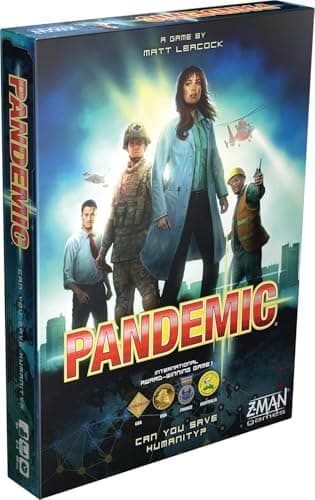
Everyone plays on the same side against the board, which removes the single biggest reason board game gifts fail: somebody has to lose. Z-Man states 2 to 4 players, ages 8+, 45 minutes.
#ad Price as of October 16, 2026, from Amazon. Prices change. How we make money.
What it actually is
A cooperative game. Diseases spread across a world map each turn and the players, each with a different special ability, work together to contain them.
What the publisher states
| Figure | Value | Source |
|---|---|---|
| Players | 2-4 | Z-Man Games, published product page |
| Age | 8+ | Z-Man Games, published product page |
| Playing time | 45 min | Z-Man Games, published product page |
Read from the publisher’s own page. Where a publisher does not state a figure, there is no row for it here.
What is good about it
- Nobody loses to anybody else, which suits competitive families remarkably well
- Different roles each game, so it does not repeat
- Losing together is genuinely fun, which is a strange and useful property
What is not
- One confident player can end up telling everyone else what to do
- You will lose the first few times, and some recipients hate that
- Caps at four
Who should skip it
Skip it for a group with one dominant personality - cooperative games are where that becomes a problem, not where it gets solved.
How it scored as a gift
- Easy to explain7.8
- Works for non-gamers8.4
- Group size range7.0
- Repeat plays8.8
- Feels like a gift9.0
Gift fit 8.5 / 10. That is our editorial judgment of how safe and well-aimed this is as a present, read off the published specifications - not a verdict on how good the game is, and not a test result. It is deliberately not marked up as a rating in this page’s structured data. How we pick.
Sushi Go!
Gamewright · A small, cheap gift that is actually good
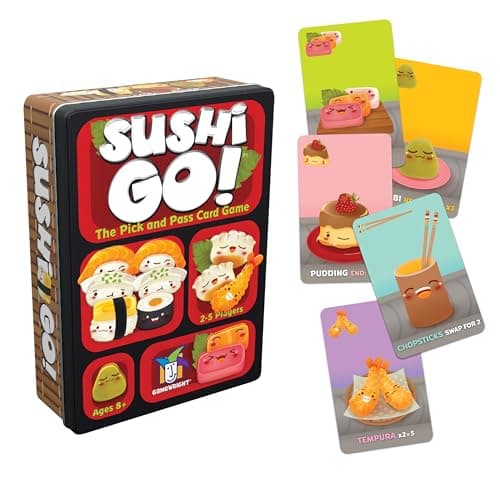
A tin of cards, fifteen minutes, and one of the best value-for-money gifts in the whole category. You pass hands of cards around and try to collect the sets that score well together.
#ad Price as of October 16, 2026, from Amazon. Prices change. How we make money.
What it actually is
A card game where you pick one card from your hand, pass the rest to your neighbor, and repeat - so every hand you see has already been picked over.
What the publisher states
| Figure | Value | Source |
|---|---|---|
| Players | 2-5 | Gamewright, published product page |
| Age | 8+ | Gamewright, published product page |
| Length | 15 min | Gamewright, published product page |
Read from the publisher’s own page. Where a publisher does not state a figure, there is no row for it here.
What is good about it
- Fits in a coat pocket, so it travels and it fits a stocking
- Fifteen minutes means a household plays it three times in a sitting
- Cheap enough to give alongside something else
What is not
- Caps at five - Sushi Go Party! is the version that seats eight
- Scoring is fiddly the first time through
- Almost too small to feel like a main present on its own
Who should skip it
Skip it as a sole main gift for an adult - it reads as a stocking filler no matter how good it is. Give it alongside something larger.
How it scored as a gift
- Easy to explain9.2
- Works for non-gamers9.2
- Group size range7.8
- Repeat plays8.6
- Feels like a gift7.4
Gift fit 8.9 / 10. That is our editorial judgment of how safe and well-aimed this is as a present, read off the published specifications - not a verdict on how good the game is, and not a test result. It is deliberately not marked up as a rating in this page’s structured data. How we pick.
Carcassonne
Z-Man Games · A family with a genuinely mixed age range
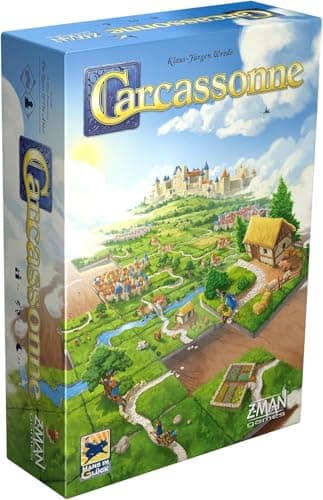
You draw a tile, you put it down so the roads and fields line up, and sometimes you put a little wooden person on it. Z-Man's stated age floor is 7, the lowest of any full board game here, and it plays two to five.
#ad Price as of October 16, 2026, from Amazon. Prices change. How we make money.
What it actually is
A tile-laying game. The board is built as you play, one square tile at a time, and you claim the roads, cities and fields you help complete.
What the publisher states
| Figure | Value | Source |
|---|---|---|
| Players | 2-5 | Z-Man Games, published product page |
| Age | 7+ | Z-Man Games, published product page |
| Playing time | 30-45 min | Z-Man Games, published product page |
Read from the publisher’s own page. Where a publisher does not state a figure, there is no row for it here.
What is good about it
- An age floor of 7 with no reading required at all
- Genuinely playable at two, which most family games are not
- No two games start the same, because the board is different every time
What is not
- Field scoring at the end confuses almost everybody the first time
- A run of unhelpful tiles feels like bad luck rather than a decision
- The little wooden figures are exactly the size a toddler will eat
Who should skip it
Skip it for a group of six or more, and skip it for anyone who wants the scoring to be obvious - the farms rule is the one everybody argues about.
How it scored as a gift
- Easy to explain8.6
- Works for non-gamers9.0
- Group size range8.6
- Repeat plays9.2
- Feels like a gift8.8
Gift fit 8.8 / 10. That is our editorial judgment of how safe and well-aimed this is as a present, read off the published specifications - not a verdict on how good the game is, and not a test result. It is deliberately not marked up as a rating in this page’s structured data. How we pick.
How these were picked
We have not played these games and we do not pretend to have. What we did was read each publisher’s own page, take their stated player count, playing time and age band, check that every pick genuinely fits the constraint in this page’s title, confirm it is still being sold, and pull a live price rather than a remembered one. Every figure here names the publisher it came from, so you can check it yourself in about a minute.
How we pick sets out the full method, including what would change a ranking.
Questions people ask
+−What does co-op mean in board games?
Everybody plays on the same side against the game itself rather than against each other, so the group wins or loses together. Pandemic and Forbidden Island are the clearest examples we cover.
+−What is a meeple?
The small wooden figure roughly shaped like a person, used as a player piece. The word comes from Carcassonne and is now used for any wooden player token - and it is where the first half of this site’s name comes from.
+−What does drafting mean?
You are dealt a hand of cards, keep one, and pass the rest to the player next to you - then repeat with the hand you have just been given. Sushi Go! and 7 Wonders both work this way.
+−What is the difference between a base game and an expansion?
A base game is complete on its own. An expansion adds to a base game and cannot be played without it, which is one of the easier mistakes to make when buying a gift. Check the box says base game if you are not sure.