Head to head
Pandemic vs Forbidden Island
Two cooperative games where everybody plays on the same side. One is the cheaper way to find out whether that suits your household; the other is where you end up.
By Scooter M. · Published · Last updated
How this page is funded: the buy links below are affiliate links. If you buy through one, we earn a commission at no extra cost to you. It does not change the order of the picks or what we say about them. Full disclosure.
Games we claim to have play-tested: 0. Every gift guide in this category implies a shelf of played games behind it. We do not have one, and we would rather say so. What we do instead is on this page: the publisher’s own player count, playing time and age band for every pick, cited to the publisher; a live price rather than a remembered one; and a plain answer on who should skip each game.
The short answer
Forbidden Island has no buyable Amazon listing at the moment, so if you are choosing today the answer is Pandemic - Z-Man states 2-4 players, ages 8+, 45 minutes, and it is the fuller game of the two. Gamewright still lists Forbidden Island as a current product, and if you can find it in a shop it is the cheaper and shorter way into cooperative games at 2-4 players, 10+, 30 minutes. The comparison below is unchanged - only where you can buy one of them has.
Side by side
| Forbidden Island | Pandemic | |
|---|---|---|
| Players | 2-4 | 2-4 |
| Playing time | 30 min | 45 min |
| Age | 10+ | 8+ |
| Publisher | Gamewright | Z-Man Games |
| Everyone on the same side? | Yes | Yes |
| Roles with abilities | Yes | Yes |
| Packaging | A metal tin | A full-size box |
They are the same idea at two sizes
Both are cooperative: the group plays against the board, everybody has a role with a special ability, and you win or lose together. Both were designed by the same person, and Forbidden Island is often described as the smaller sibling.
The differences are scale rather than kind. Pandemic has a world map, four diseases, a larger deck and more ways for things to go wrong. Forbidden Island has a small grid of tiles that sink, four treasures to collect, and a much shorter runway.
Forbidden Island wins on
- Price - it is one of the cheapest real board games we cover
- Length - 30 minutes against 45
- Simplicity - fewer moving parts to explain before the first turn
- Durability - it ships in a metal tin that survives a cupboard
Pandemic wins on
- Depth - more roles, more decisions, more ways to lose
- Age floor - Z-Man states 8+ against Gamewright’s 10+
- Longevity - experienced players beat Forbidden Island reliably; Pandemic keeps beating them back
- Presentation - a full-size box, which matters if it is the main present
The problem both of them share
In any cooperative game, one confident player can end up directing everybody else’s turns, because all the information is public and the group is trying to play optimally. It is worth knowing before you buy: a cooperative game does not solve a dominant personality, it surfaces one.
If that describes the household, a competitive game is often the kinder choice - Ticket to Ride or Carcassonne, where everybody plays their own game.
The honest recommendation
On the games alone: Forbidden Island for a household trying a cooperative game for the first time, because it costs little and takes half an hour, and Pandemic for one that already knows it likes playing together, because it lasts far longer before it is solved.
On what you can actually buy today: Pandemic. Forbidden Island is worth picking up if you see it in a shop, but we will not send you to a listing that is not there. If the appeal was the smaller, cheaper cooperative box rather than Forbidden Island specifically, Forbidden Jungle and Forbidden Desert are the Gamewright cooperative games currently on the shelf, and both are on our cooperative games page.
What we would buy for this
Chosen from the same registry as our roundups, on the publisher's own figures and a live price.
Pandemic
Z-Man Games · A family where losing is taken personally
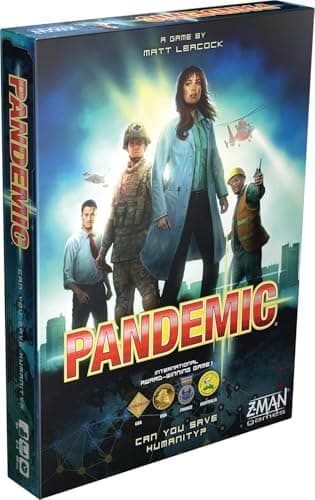
Everyone plays on the same side against the board, which removes the single biggest reason board game gifts fail: somebody has to lose. Z-Man states 2 to 4 players, ages 8+, 45 minutes.
#ad Price as of October 16, 2026, from Amazon. Prices change. How we make money.
What it actually is
A cooperative game. Diseases spread across a world map each turn and the players, each with a different special ability, work together to contain them.
What the publisher states
| Figure | Value | Source |
|---|---|---|
| Players | 2-4 | Z-Man Games, published product page |
| Age | 8+ | Z-Man Games, published product page |
| Playing time | 45 min | Z-Man Games, published product page |
Read from the publisher’s own page. Where a publisher does not state a figure, there is no row for it here.
What is good about it
- Nobody loses to anybody else, which suits competitive families remarkably well
- Different roles each game, so it does not repeat
- Losing together is genuinely fun, which is a strange and useful property
What is not
- One confident player can end up telling everyone else what to do
- You will lose the first few times, and some recipients hate that
- Caps at four
Who should skip it
Skip it for a group with one dominant personality - cooperative games are where that becomes a problem, not where it gets solved.
How it scored as a gift
- Easy to explain7.8
- Works for non-gamers8.4
- Group size range7.0
- Repeat plays8.8
- Feels like a gift9.0
Gift fit 8.5 / 10. That is our editorial judgment of how safe and well-aimed this is as a present, read off the published specifications - not a verdict on how good the game is, and not a test result. It is deliberately not marked up as a rating in this page’s structured data. How we pick.
How these were picked
We have not played these games and we do not pretend to have. What we did was read each publisher’s own page, take their stated player count, playing time and age band, check that every pick genuinely fits the constraint in this page’s title, confirm it is still being sold, and pull a live price rather than a remembered one. Every figure here names the publisher it came from, so you can check it yourself in about a minute.
How we pick sets out the full method, including what would change a ranking.
Questions people ask
+−Is Pandemic or Forbidden Island better?
Pandemic has more in it - Z-Man states 2-4 players, 8+, 45 minutes. Forbidden Island is cheaper and shorter at 2-4 players, 10+, 30 minutes from Gamewright, which makes it the better first cooperative game for a household that has never tried one. In practice Pandemic wins by default at the moment, because Forbidden Island has no buyable listing and Pandemic does.
+−Which is better for children?
Pandemic, on the publishers’ own numbers: Z-Man states 8+ against Gamewright’s 10+ for Forbidden Island. Both are cooperative, so no child is losing to an adult in either.
+−Do cooperative games get boring once you win?
Forbidden Island does, sooner - experienced players develop a routine that beats it reliably. Pandemic has more variation in roles and setup and holds up longer, which is most of what the extra money buys.
+−What is the problem with cooperative board games?
One player can end up directing everybody else’s turns, because all the information is public and the group is trying to play optimally. That is a property of the format rather than of either game, and it is worth knowing about your household before buying.