Guide
Five Ways a Board Game Gift Goes Wrong
Board game gifts fail in a small number of predictable ways. Each has a specific check that takes about ten seconds.
By Scooter M. · Published · Last updated
How this page is funded: the buy links below are affiliate links. If you buy through one, we earn a commission at no extra cost to you. It does not change the order of the picks or what we say about them. Full disclosure.
Games we claim to have play-tested: 0. Every gift guide in this category implies a shelf of played games behind it. We do not have one, and we would rather say so. What we do instead is on this page: the publisher’s own player count, playing time and age band for every pick, cited to the publisher; a live price rather than a remembered one; and a plain answer on who should skip each game.
The short answer
The five failures are: buying for a group that does not exist, buying past the time they actually have, ignoring the publisher’s age rating, buying competitive for a household that argues, and buying an expensive box as somebody’s first game. Each has a ten-second check.
None of these are about taste, and that is the point. A board game gift almost never fails because the recipient did not like the theme. It fails because a practical constraint was missed, and the box stayed on a shelf.
1. Buying for a group that does not exist
By some distance the most common failure. A four-player game given to somebody who spends most evenings with one other person is a box, however good it is.
The check: how many people are usually in the room? If the answer is two, buy from the two-player list. Publisher player counts are hard limits: CATAN states 3-4 players and cannot be played by a couple.
2. Buying past the time they actually have
The second most common. A household with young children has about thirty minutes after bedtime, not ninety. A 60-minute game in that house does not get played once.
The check: take the publisher’s stated time, add ten minutes for the first play, and compare that to the window they genuinely have. If they are close, go one band shorter. Our playing-time table lists every game we cover.
3. Ignoring the age rating
Board game age ratings are set by the publisher and are usually accurate - they measure rules complexity and reading load rather than safety. Two catch people out regularly: The Chameleon is 14+ by Big Potato’s own rating, and Monikers is 17 and up by CMYK’s.
The check: find the youngest person who will be expected to play, and check the publisher’s stated floor. Our age guide lists all of them.
4. Buying competitive for a household that argues
Some families genuinely cannot play a competitive game without it going wrong. That is a fact about the family, not a flaw in them, and it has a clean solution.
The check: does anybody here take losing badly? If yes, buy a cooperative game. Pandemic (Z-Man: 2-4 players, 8+, 45 minutes), Forbidden Desert (Gamewright: 2-5, 10+, 45 minutes) and Just One (Repos: 3-7, 8+, 20 minutes) all put everybody on the same side.
5. Buying an expensive box as somebody’s first game
A larger, longer game is a worse introduction, not a better one. The first play is the least enjoyable version of any game, and on a 70-minute box that first play is a long evening spent being taught.
The check: is this their first board game as an adult? If yes, spend less. Codenames at the $20-30 mark outscores everything above $50 on this site precisely because it is short and simple.
Two smaller mistakes worth avoiding
| Mistake | Why it matters | The fix |
|---|---|---|
| Buying an expansion for a game they do not own | Expansions are unplayable without the base game and it is not always obvious from the box. | Check the box says base game, or that you have seen the original on their shelf. |
| Buying a second copy of something they already have | Common with popular titles, and awkward to raise. | Include a gift receipt. It is normal for this category, not an insult. |
What we would buy for this
Chosen from the same registry as our roundups, on the publisher's own figures and a live price.
Codenames
Czech Games Edition · The gift you give when you know almost nothing about the person
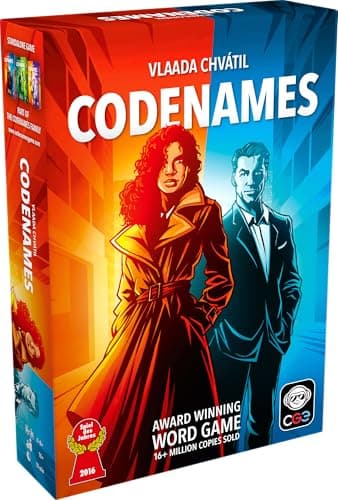
The single safest board game gift there is. Two teams, a grid of words, and one person giving one-word clues. It explains in about a minute, it works at four people or ten, and nobody has to read a rulebook to enjoy it.
#ad Price as of October 16, 2026, from Amazon. Prices change. How we make money.
What it actually is
A word game. The room splits into two teams; one person on each team can see which words belong to their side and gives a single-word clue to point their teammates at them.
What the publisher states
| Figure | Value | Source |
|---|---|---|
| Players | 4-8+ | Czech Games Edition, published game page |
| Age | 10+ | Czech Games Edition, published game page |
| Length | 15 min | Czech Games Edition, published game page |
Read from the publisher’s own page. Where a publisher does not state a figure, there is no row for it here.
What is good about it
- Teaches faster than almost anything else on this site - the core rule is one sentence
- Scales past its printed maximum, because extra people simply join a team
- Everyone talks, including the people who are losing
What is not
- The two clue-givers do most of the thinking; quiet guessers can drift
- Wants an even-ish split into two teams, so it is awkward at exactly three
- Word games do not suit everybody, and you cannot always tell in advance
Who should skip it
Skip it for a group of two or three - it wants teams. Skip it for someone who dislikes word games, or who is playing in a second language.
How it scored as a gift
- Easy to explain9.8
- Works for non-gamers9.7
- Group size range9.4
- Repeat plays9.2
- Feels like a gift8.8
Gift fit 9.6 / 10. That is our editorial judgment of how safe and well-aimed this is as a present, read off the published specifications - not a verdict on how good the game is, and not a test result. It is deliberately not marked up as a rating in this page’s structured data. How we pick.
Ticket to Ride
Days of Wonder · A household that owns no board games at all
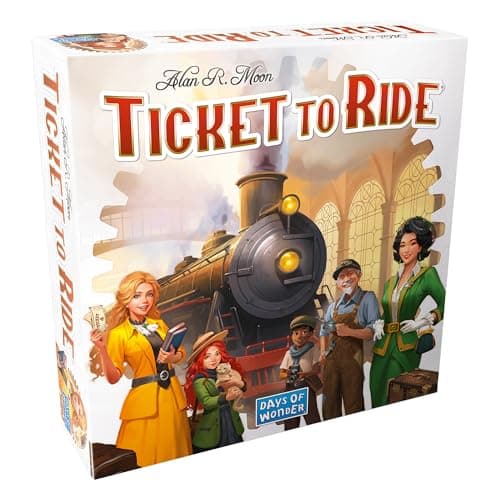
The default answer to 'we want a proper board game and nobody here plays board games'. You collect colored cards and use them to claim railway routes across a map of the United States. That is the whole idea, and it is enough.
#ad Price as of October 16, 2026, from Amazon. Prices change. How we make money.
What it actually is
A route-building game. You gather sets of matching cards and spend them to place little plastic trains along the lines between cities.
What the publisher states
| Figure | Value | Source |
|---|---|---|
| Players | 2-5 | Days of Wonder, published game page |
| Age | 8+ | Days of Wonder, published game page |
| Playing time | 30-60 min | Days of Wonder, published game page |
Read from the publisher’s own page. Where a publisher does not state a figure, there is no row for it here.
What is good about it
- One of the shortest explanations of any full-size board game: collect cards, claim routes
- Two to five players from one box, and it is decent at every count in that range
- The map and the trains do a lot of the work of making it feel like an occasion
What is not
- Someone can take the route you needed, and new players take that badly
- At the 60-minute end it outstays its welcome with restless players
- The plastic trains are small enough to lose under a sofa
Who should skip it
Skip it for a group of six or more - the box stops at five - and skip it for someone who wants a fifteen-minute game.
How it scored as a gift
- Easy to explain9.0
- Works for non-gamers9.6
- Group size range8.6
- Repeat plays9.0
- Feels like a gift9.8
Gift fit 9.5 / 10. That is our editorial judgment of how safe and well-aimed this is as a present, read off the published specifications - not a verdict on how good the game is, and not a test result. It is deliberately not marked up as a rating in this page’s structured data. How we pick.
Pandemic
Z-Man Games · A family where losing is taken personally
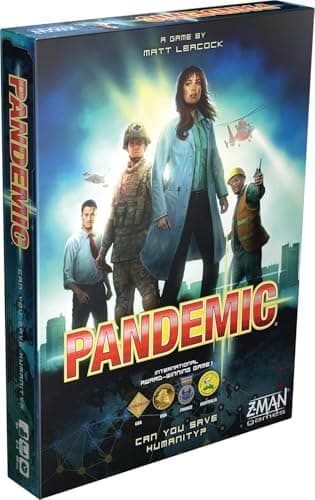
Everyone plays on the same side against the board, which removes the single biggest reason board game gifts fail: somebody has to lose. Z-Man states 2 to 4 players, ages 8+, 45 minutes.
#ad Price as of October 16, 2026, from Amazon. Prices change. How we make money.
What it actually is
A cooperative game. Diseases spread across a world map each turn and the players, each with a different special ability, work together to contain them.
What the publisher states
| Figure | Value | Source |
|---|---|---|
| Players | 2-4 | Z-Man Games, published product page |
| Age | 8+ | Z-Man Games, published product page |
| Playing time | 45 min | Z-Man Games, published product page |
Read from the publisher’s own page. Where a publisher does not state a figure, there is no row for it here.
What is good about it
- Nobody loses to anybody else, which suits competitive families remarkably well
- Different roles each game, so it does not repeat
- Losing together is genuinely fun, which is a strange and useful property
What is not
- One confident player can end up telling everyone else what to do
- You will lose the first few times, and some recipients hate that
- Caps at four
Who should skip it
Skip it for a group with one dominant personality - cooperative games are where that becomes a problem, not where it gets solved.
How it scored as a gift
- Easy to explain7.8
- Works for non-gamers8.4
- Group size range7.0
- Repeat plays8.8
- Feels like a gift9.0
Gift fit 8.5 / 10. That is our editorial judgment of how safe and well-aimed this is as a present, read off the published specifications - not a verdict on how good the game is, and not a test result. It is deliberately not marked up as a rating in this page’s structured data. How we pick.
How these were picked
We have not played these games and we do not pretend to have. What we did was read each publisher’s own page, take their stated player count, playing time and age band, check that every pick genuinely fits the constraint in this page’s title, confirm it is still being sold, and pull a live price rather than a remembered one. Every figure here names the publisher it came from, so you can check it yourself in about a minute.
How we pick sets out the full method, including what would change a ranking.
Questions people ask
+−What is the most common mistake when buying a board game as a gift?
Buying for a group that does not exist. A four-player game given to somebody who usually has one other person around cannot be played. Check the number of people first, and treat the publisher’s stated player count as a hard limit.
+−How do I avoid buying a board game that is too complicated?
Use the publisher’s stated playing time as a proxy. Under about 30 minutes almost always means a game you can teach in a minute or two. Over an hour usually means a rulebook somebody has to read first.
+−What should I buy for a family that argues over games?
A cooperative game, where everybody plays on the same side against the board. Pandemic, Forbidden Desert and Just One are the three we recommend most for this, and all three are on our family page.
+−Is it rude to include a gift receipt with a board game?
No. Board games are one of the categories where the recipient may already own the exact item, and a gift receipt is normal and sensible rather than a signal that you did not think about it.