Guide
How Much Do Board Games Cost?
Board games run from about $12 to well past $100, and the price tracks what is physically in the box far more closely than it tracks how good the game is.
By Scooter M. · Published · Last updated
How this page is funded: the buy links below are affiliate links. If you buy through one, we earn a commission at no extra cost to you. It does not change the order of the picks or what we say about them. Full disclosure.
Games we claim to have play-tested: 0. Every gift guide in this category implies a shelf of played games behind it. We do not have one, and we would rather say so. What we do instead is on this page: the publisher’s own player count, playing time and age band for every pick, cited to the publisher; a live price rather than a remembered one; and a plain answer on who should skip each game.
The short answer
Board games fall into four price bands. Card games in small boxes run roughly $12 to $20. Boxed card and party games run $20 to $30. Full-size board games with a board and plastic pieces run $30 to $50. Large illustrated games with unusual components run $50 to $100. Price tracks what is physically in the box, not how good the game is.
This is the question people ask before any other one, and most answers to it are vague on purpose. It is hard to be specific because publishers mostly do not publish prices and retailers change theirs constantly.
So here is what we can actually stand behind. Below is every publisher list price we could read directly from a publisher’s own online store on 1 September 2026. These are not retail prices - a shop will usually be lower - but they are the publisher’s own number rather than anybody’s recollection.
| Game | Publisher list price | What is in the box | Publisher |
|---|---|---|---|
| Happy Salmon | $12.99 | Cards in a cloth pouch | Exploding Kittens |
| A Little Wordy | $14.99 | Letter tiles and cards | Exploding Kittens |
| The Mind | $17.95 | A deck of numbered cards | Pandasaurus Games |
| Exploding Kittens | $19.99 | A deck of illustrated cards | Exploding Kittens |
| Poetry for Neanderthals | $19.99 | Cards and an inflatable club | Exploding Kittens |
| Blokus | $21.99 | A board and 84 plastic shapes | Mattel |
| Herd Mentality | $24.99 | Cards, boards, pens and a cow | Big Potato Games |
| The Chameleon | $24.99 | Cards and a code grid | Big Potato Games |
Most publishers we cover - Czech Games Edition, Days of Wonder, Z-Man, Repos Production, Space Cowboys, Gamewright, Gen42, Lookout - do not publish a price on the game page at all. Rather than guess at their numbers, this site puts a live retail price inside every buy button, refreshed daily, and says plainly when we do not hold one.
What each band actually buys you
$12 to $20: card games in small boxes
A deck of cards, sometimes a few tokens, in a tin or a small box. There is no board and no plastic, because those are what cost money to manufacture. What you get for the money is design rather than components - and several of the best short games we cover live here. See our under $20 page.
$20 to $30: the most productive band in the hobby
Still mostly cards, but bigger boxes and better production. This is where Codenames, Just One, Jaipur, Skull and Hive sit, and it is the band we would send almost anybody to first. If you are buying the game that will get played most rather than the game that looks most impressive, it is probably here.
$30 to $50: a board and pieces
A printed board, molded plastic, illustrated tiles, and a box with weight. Ticket to Ride, Carcassonne, Pandemic and Splendor all sit here. This is the level where a board game starts to read as a proper present when it is unwrapped.
$50 to $100: objects
Large illustrated games with unusual components - Wingspan’s egg miniatures and birdfeeder dice tower are the clearest example. Above about $50 the money buys presentation and material rather than design quality. That is a real thing to want when the game is the main present. It is not a better game.
When spending more is genuinely pointless
If the recipient has never played a board game as an adult, the expensive box is the worse gift. It is longer, it has more rules, and the first play - which is the one that decides whether they ever play again - will be the least enjoyable version of it.
The best gift on this site by our own scoring is Codenames, which sits in the $20 to $30 band. That is not an accident: the properties that make a game a good gift are short rules and short length, and neither of those costs money.
Two things that genuinely justify spending more
Component durability with children. Thicker tiles, molded plastic and a rigid box survive a household with young children far better than a card game will. That is a practical case for the $30-$50 band rather than a vanity one.
The gift has to be the present. A $15 card game cannot carry a significant birthday on its own, no matter how good it is. Presentation is a real requirement, and our under $100 page is what it is for.
What we would buy for this
Chosen from the same registry as our roundups, on the publisher's own figures and a live price.
Sushi Go!
Gamewright · A small, cheap gift that is actually good
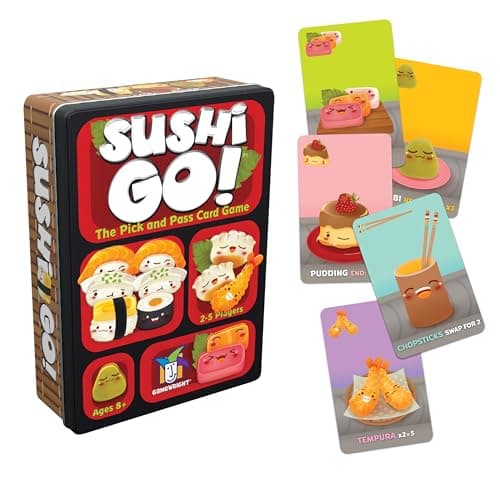
A tin of cards, fifteen minutes, and one of the best value-for-money gifts in the whole category. You pass hands of cards around and try to collect the sets that score well together.
#ad Price as of October 16, 2026, from Amazon. Prices change. How we make money.
What it actually is
A card game where you pick one card from your hand, pass the rest to your neighbor, and repeat - so every hand you see has already been picked over.
What the publisher states
| Figure | Value | Source |
|---|---|---|
| Players | 2-5 | Gamewright, published product page |
| Age | 8+ | Gamewright, published product page |
| Length | 15 min | Gamewright, published product page |
Read from the publisher’s own page. Where a publisher does not state a figure, there is no row for it here.
What is good about it
- Fits in a coat pocket, so it travels and it fits a stocking
- Fifteen minutes means a household plays it three times in a sitting
- Cheap enough to give alongside something else
What is not
- Caps at five - Sushi Go Party! is the version that seats eight
- Scoring is fiddly the first time through
- Almost too small to feel like a main present on its own
Who should skip it
Skip it as a sole main gift for an adult - it reads as a stocking filler no matter how good it is. Give it alongside something larger.
How it scored as a gift
- Easy to explain9.2
- Works for non-gamers9.2
- Group size range7.8
- Repeat plays8.6
- Feels like a gift7.4
Gift fit 8.9 / 10. That is our editorial judgment of how safe and well-aimed this is as a present, read off the published specifications - not a verdict on how good the game is, and not a test result. It is deliberately not marked up as a rating in this page’s structured data. How we pick.
Codenames
Czech Games Edition · The gift you give when you know almost nothing about the person
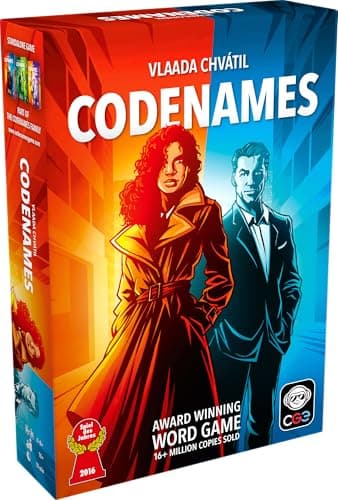
The single safest board game gift there is. Two teams, a grid of words, and one person giving one-word clues. It explains in about a minute, it works at four people or ten, and nobody has to read a rulebook to enjoy it.
#ad Price as of October 16, 2026, from Amazon. Prices change. How we make money.
What it actually is
A word game. The room splits into two teams; one person on each team can see which words belong to their side and gives a single-word clue to point their teammates at them.
What the publisher states
| Figure | Value | Source |
|---|---|---|
| Players | 4-8+ | Czech Games Edition, published game page |
| Age | 10+ | Czech Games Edition, published game page |
| Length | 15 min | Czech Games Edition, published game page |
Read from the publisher’s own page. Where a publisher does not state a figure, there is no row for it here.
What is good about it
- Teaches faster than almost anything else on this site - the core rule is one sentence
- Scales past its printed maximum, because extra people simply join a team
- Everyone talks, including the people who are losing
What is not
- The two clue-givers do most of the thinking; quiet guessers can drift
- Wants an even-ish split into two teams, so it is awkward at exactly three
- Word games do not suit everybody, and you cannot always tell in advance
Who should skip it
Skip it for a group of two or three - it wants teams. Skip it for someone who dislikes word games, or who is playing in a second language.
How it scored as a gift
- Easy to explain9.8
- Works for non-gamers9.7
- Group size range9.4
- Repeat plays9.2
- Feels like a gift8.8
Gift fit 9.6 / 10. That is our editorial judgment of how safe and well-aimed this is as a present, read off the published specifications - not a verdict on how good the game is, and not a test result. It is deliberately not marked up as a rating in this page’s structured data. How we pick.
Ticket to Ride
Days of Wonder · A household that owns no board games at all
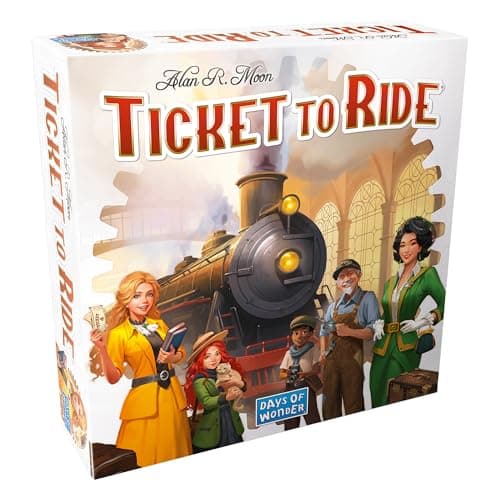
The default answer to 'we want a proper board game and nobody here plays board games'. You collect colored cards and use them to claim railway routes across a map of the United States. That is the whole idea, and it is enough.
#ad Price as of October 16, 2026, from Amazon. Prices change. How we make money.
What it actually is
A route-building game. You gather sets of matching cards and spend them to place little plastic trains along the lines between cities.
What the publisher states
| Figure | Value | Source |
|---|---|---|
| Players | 2-5 | Days of Wonder, published game page |
| Age | 8+ | Days of Wonder, published game page |
| Playing time | 30-60 min | Days of Wonder, published game page |
Read from the publisher’s own page. Where a publisher does not state a figure, there is no row for it here.
What is good about it
- One of the shortest explanations of any full-size board game: collect cards, claim routes
- Two to five players from one box, and it is decent at every count in that range
- The map and the trains do a lot of the work of making it feel like an occasion
What is not
- Someone can take the route you needed, and new players take that badly
- At the 60-minute end it outstays its welcome with restless players
- The plastic trains are small enough to lose under a sofa
Who should skip it
Skip it for a group of six or more - the box stops at five - and skip it for someone who wants a fifteen-minute game.
How it scored as a gift
- Easy to explain9.0
- Works for non-gamers9.6
- Group size range8.6
- Repeat plays9.0
- Feels like a gift9.8
Gift fit 9.5 / 10. That is our editorial judgment of how safe and well-aimed this is as a present, read off the published specifications - not a verdict on how good the game is, and not a test result. It is deliberately not marked up as a rating in this page’s structured data. How we pick.
Wingspan
Stonemaier Games · A gift that has to look impressive when it is opened
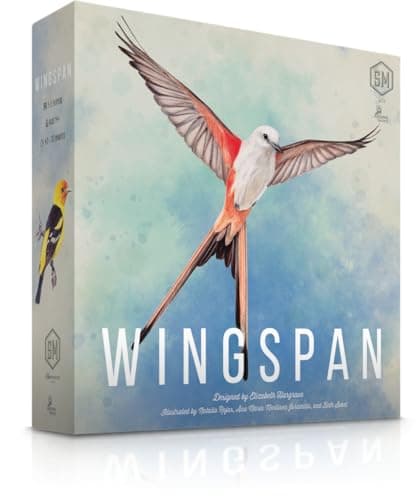
The prettiest box you can give someone. Stonemaier states 1 to 5 players and 40 to 70 minutes; it does not publish an age band on its game page, so this site does not state one either.
#ad Price as of October 16, 2026, from Amazon. Prices change. How we make money.
What it actually is
A card game about attracting birds to a wildlife reserve. Each bird you play makes one of your three actions a little better for the rest of the game.
What the publisher states
| Figure | Value | Source |
|---|---|---|
| Players | 1-5 | Stonemaier Games, published game page |
| Game length | 40-70 mins | Stonemaier Games, published game page |
| Setup time | 5 mins | Stonemaier Games, published game page |
Read from the publisher’s own page. Where a publisher does not state a figure, there is no row for it here.
What is good about it
- Genuinely beautiful - illustrated bird cards, a dice tower shaped like a birdfeeder
- A solo mode is included in the base box
- The subject matter appeals to people who do not care about games at all
What is not
- Stonemaier does not publish an age band on the game page, so we cannot quote one
- Seventy minutes at the top end, and the first game runs longer than that
- It is the most expensive game on this site by some distance
Who should skip it
Skip it for a household that wants a quick game after dinner, and skip it as a first-ever board game - the rules reward a second play more than a first.
How it scored as a gift
- Easy to explain6.8
- Works for non-gamers7.6
- Group size range8.6
- Repeat plays9.6
- Feels like a gift10.0
Gift fit 8.8 / 10. That is our editorial judgment of how safe and well-aimed this is as a present, read off the published specifications - not a verdict on how good the game is, and not a test result. It is deliberately not marked up as a rating in this page’s structured data. How we pick.
How these were picked
We have not played these games and we do not pretend to have. What we did was read each publisher’s own page, take their stated player count, playing time and age band, check that every pick genuinely fits the constraint in this page’s title, confirm it is still being sold, and pull a live price rather than a remembered one. Every figure here names the publisher it came from, so you can check it yourself in about a minute.
How we pick sets out the full method, including what would change a ranking.
Questions people ask
+−How much should I spend on a board game?
$20 to $30 buys the best games for the money and is where we would send most people. $30 to $50 buys a proper boxed board game that looks like a present. Above $50 you are buying presentation rather than a better game.
+−Why are some board games so expensive?
Components. A board, molded plastic pieces, wooden tokens, illustrated tiles and a rigid box all cost money to manufacture in a way a deck of cards does not. Wingspan is expensive because of what is physically in the box, not because the rules are cleverer.
+−Are cheap board games any good?
Often, yes. Sushi Go!, Love Letter and The Mind are all under $20 by publisher list price or close to it, and all three are genuinely well-designed. What you give up at that level is presentation and length, not design.
+−Where do the prices on this site come from?
The number inside each buy button is a live retail price from Amazon, refreshed daily. The list prices in the table above were read from each publisher’s own store on 1 September 2026. We never print a price from memory, and where we do not hold a current one the button says so.