Head to head
Ticket to Ride vs Ticket to Ride: Europe
Days of Wonder states the same player count, age and playing time for both. The difference is the map and three rules, and which one you should buy depends on who is going to lose.
By Scooter M. · Published · Last updated
How this page is funded: the buy links below are affiliate links. If you buy through one, we earn a commission at no extra cost to you. It does not change the order of the picks or what we say about them. Full disclosure.
Games we claim to have play-tested: 0. Every gift guide in this category implies a shelf of played games behind it. We do not have one, and we would rather say so. What we do instead is on this page: the publisher’s own player count, playing time and age band for every pick, cited to the publisher; a live price rather than a remembered one; and a plain answer on who should skip each game.
The short answer
Buy Ticket to Ride: Europe if the people playing are adults or regular gamers - Days of Wonder states 2-5 players, ages 8+, 30-60 minutes, and its stations forgive the mistake that ruins a first game. Buy the original Ticket to Ride for a household with children or for somebody who has never played a modern board game: the same figures, a simpler map, nothing extra to explain.
Side by side
| Ticket to Ride | Ticket to Ride: Europe | |
|---|---|---|
| Players | 2-5 | 2-5 |
| Playing time | 30-60 min | 30-60 min |
| Age | 8+ | 8+ |
| Publisher | Days of Wonder | Days of Wonder |
| Map | United States | Europe |
| Standalone game? | Yes | Yes |
| Tunnels and ferries | No | Yes |
| Stations | No | Yes |
The first thing to know is that neither is an expansion. Both are complete games in their own box, and buying one does not require the other. The publisher states identical figures for both, which is unusual and is the reason this choice confuses people in a shop.
What Europe actually adds
Three things, all described on Days of Wonder’s own page for the game.
Tunnels and ferries. Some routes are tunnels: you commit your cards, then flip three more from the deck, and any matching cards mean you must pay extra or take everything back. Ferries need locomotive cards specifically. The publisher’s own designer notes say these “add some more luck to the game” - which is exactly the trade you are making.
Stations. Each player gets three, and a station lets you use one route another player has already claimed. This is the important one for a gift: in the original game, having your only route taken can leave a ticket uncompletable and a player stuck watching. Stations mean a bad turn costs you points rather than the evening.
A different map. Days of Wonder describes Europe as having many more small routes and no obvious network choice like the coast-to-coast strategy in the USA. In practice that means fewer long, table-defining routes and more small decisions.
Which to buy first
For a family with children, buy the original. Days of Wonder states 8+ for both, but the original has three fewer rules to explain and no tunnel gamble to understand. A simpler map is also easier for a child to plan on: the long routes are obvious and the goal is visible from across the table.
For adults, buy Europe. The stations solve the format’s worst moment, the tunnels add a decision to a turn that would otherwise be automatic, and the map rewards a second and third game more than the American one does.
For somebody who already owns one, the other is a genuinely different evening rather than more of the same, which is not true of the map expansions. If you are choosing what to buy after enjoying either of them, we cover that on board games like Ticket to Ride.
What does not differ
Everything that makes Ticket to Ride a good gift is true of both. You collect colored train cards, spend matching sets to claim a route between two cities, and score for completing the destination tickets in your hand. Turns take seconds, the whole board is public information, and there is no reading beyond city names.
Both also share the same weakness: a player who draws badly early can spend a long stretch collecting cards while other people build. Europe’s stations soften the consequence; neither version removes the wait.
The honest recommendation
If this is a present and you know nothing about the recipient beyond their address, buy the original Ticket to Ride. It is the more recognizable box, the simpler game, and the one that suits the widest range of tables - it is our top pick on the best board games of all time for that reason.
If you know the household plays games together and the recipient is not a child, Europe is the better version of the same game, and the stations are the reason. Full figures for both are on our Ticket to Ride review.
What we would buy for this
Chosen from the same registry as our roundups, on the publisher's own figures and a live price.
Ticket to Ride
Days of Wonder · A household that owns no board games at all
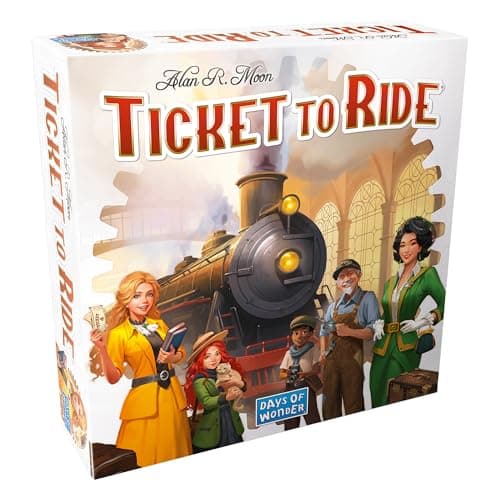
The default answer to 'we want a proper board game and nobody here plays board games'. You collect colored cards and use them to claim railway routes across a map of the United States. That is the whole idea, and it is enough.
#ad Price as of October 15, 2026, from Amazon. Prices change. How we make money.
What it actually is
A route-building game. You gather sets of matching cards and spend them to place little plastic trains along the lines between cities.
What the publisher states
| Figure | Value | Source |
|---|---|---|
| Players | 2-5 | Days of Wonder, published game page |
| Age | 8+ | Days of Wonder, published game page |
| Playing time | 30-60 min | Days of Wonder, published game page |
Read from the publisher’s own page. Where a publisher does not state a figure, there is no row for it here.
What is good about it
- One of the shortest explanations of any full-size board game: collect cards, claim routes
- Two to five players from one box, and it is decent at every count in that range
- The map and the trains do a lot of the work of making it feel like an occasion
What is not
- Someone can take the route you needed, and new players take that badly
- At the 60-minute end it outstays its welcome with restless players
- The plastic trains are small enough to lose under a sofa
Who should skip it
Skip it for a group of six or more - the box stops at five - and skip it for someone who wants a fifteen-minute game.
How it scored as a gift
- Easy to explain9.0
- Works for non-gamers9.6
- Group size range8.6
- Repeat plays9.0
- Feels like a gift9.8
Gift fit 9.5 / 10. That is our editorial judgment of how safe and well-aimed this is as a present, read off the published specifications - not a verdict on how good the game is, and not a test result. It is deliberately not marked up as a rating in this page’s structured data. How we pick.
Ticket to Ride: Europe
Days of Wonder · A first Ticket to Ride for a household with a bit of patience
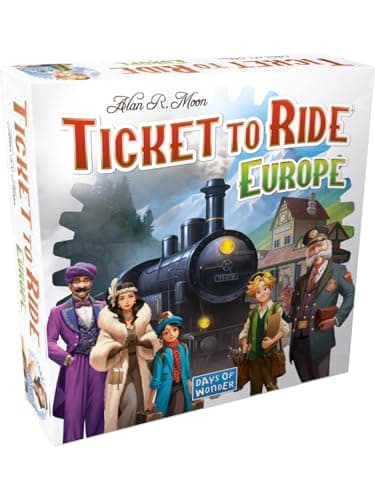
Same specifications as the original - 2 to 5 players, ages 8+, 30 to 60 minutes - on a map of Europe with tunnels, ferries and train stations added. If the recipient has never played either, this is the slightly better one.
#ad Price as of October 15, 2026, from Amazon. Prices change. How we make money.
What it actually is
The same route-building game as the original, on a European map, with a few extra rules that soften the sting of losing a route.
What the publisher states
| Figure | Value | Source |
|---|---|---|
| Players | 2-5 | Days of Wonder, published game page |
| Age | 8+ | Days of Wonder, published game page |
| Playing time | 30-60 min | Days of Wonder, published game page |
Read from the publisher’s own page. Where a publisher does not state a figure, there is no row for it here.
What is good about it
- Train stations mean a blocked player is inconvenienced rather than ruined
- The extra rules add about ninety seconds to the explanation, and no more
- Identical player count and playing time to the original, so nothing is traded away
What is not
- Two or three more rules than the original, which matters if the recipient is nervous
- Tunnels introduce a luck element some players find annoying
- Not meaningfully different once you own the original
Who should skip it
Skip it if they already own Ticket to Ride. Buy an expansion map instead of a second base game.
How it scored as a gift
- Easy to explain8.6
- Works for non-gamers9.2
- Group size range8.6
- Repeat plays9.2
- Feels like a gift9.6
Gift fit 9.0 / 10. That is our editorial judgment of how safe and well-aimed this is as a present, read off the published specifications - not a verdict on how good the game is, and not a test result. It is deliberately not marked up as a rating in this page’s structured data. How we pick.
How these were picked
We have not played these games and we do not pretend to have. What we did was read each publisher’s own page, take their stated player count, playing time and age band, check that every pick genuinely fits the constraint in this page’s title, confirm it is still being sold, and pull a live price rather than a remembered one. Every figure here names the publisher it came from, so you can check it yourself in about a minute.
How we pick sets out the full method, including what would change a ranking.
Questions people ask
+−Is Ticket to Ride: Europe an expansion?
No. It is a standalone game with its own board, trains and cards - you do not need the original to play it. Days of Wonder states 2-5 players, ages 8+, 30-60 minutes for both games.
+−Which is better, Ticket to Ride or Ticket to Ride: Europe?
Europe is the better game for adults, mainly because its stations let you use a route another player has claimed, which removes the worst outcome in the original. The original is better for children and for a first board game, because it has three fewer rules.
+−What does Ticket to Ride: Europe add?
Tunnels, ferries and stations, on Days of Wonder’s own description. Tunnels can cost extra cards after you commit, ferries require locomotives, and each player gets three stations that allow the use of a route somebody else has already taken.
+−Which Ticket to Ride should I buy for a child?
The original for ages 8 and up - Days of Wonder states 8+ - or Ticket to Ride: First Journey (2-4 players, ages 6+, 15-30 minutes) for a younger child. Europe’s tunnel rule adds a gamble that is harder to explain to a new player.
+−Can you combine Ticket to Ride and Ticket to Ride: Europe?
They are separate games with separate boards, so you play one or the other rather than both at once. Owning both gives a household two different maps and two different rule sets, which is more variety than a map expansion provides.