Head to head
Splendor vs Splendor Duel
The same gem-collecting idea in two boxes: one for a table of up to four, one rebuilt from scratch for exactly two. The number of people in the room decides this, not quality.
By Scooter M. · Published · Last updated
How this page is funded: the buy links below are affiliate links. If you buy through one, we earn a commission at no extra cost to you. It does not change the order of the picks or what we say about them. Full disclosure.
Games we claim to have play-tested: 0. Every gift guide in this category implies a shelf of played games behind it. We do not have one, and we would rather say so. What we do instead is on this page: the publisher’s own player count, playing time and age band for every pick, cited to the publisher; a live price rather than a remembered one; and a plain answer on who should skip each game.
The short answer
Buy Splendor Duel if the household is two people - Space Cowboys states 2 players, 30 minutes, and it was redesigned for that count rather than cut down to it. Buy Splendor if three or four will play - Space Cowboys states 2-4 players, ages 10+, 30 minutes. Splendor Duel is the better game at two; Splendor is the only one of the pair that works at four.
Side by side
| Splendor | Splendor Duel | |
|---|---|---|
| Players | 2-4 | 2 |
| Playing time | 30 min | 30 min |
| Age | 10+ | 10+ |
| Publisher | Space Cowboys | Space Cowboys |
| Cards | 90 development cards, 10 noble tiles | 67 jewel cards in 3 levels, 4 royal cards |
| Tokens | 40 pieces in five gem colors plus gold | 25 tokens including 2 pearls and 3 gold |
| Board | None - cards are laid out on the table | Yes - tokens are drawn from a shared board |
| Ways to win | First to 15 prestige points | Three different victory conditions |
| Extra systems | Nobles visit when you hold the right bonuses | Privilege scrolls, pearls, a token board |
What they have in common
Both are about turning gem tokens into cards, and cards into permanent discounts that make the next card cheaper. You start slow, buying almost nothing, and by the end of the half hour you are taking a card a turn for free. That curve is the whole appeal of Splendor and it is intact in both boxes.
Space Cowboys describes the original’s turn in one line - “Each turn is quick: one action, and one action only!” - and that remains true in Duel. You take tokens, or you buy a card, or you reserve one. Nothing else happens on your turn, which is why both games fit in thirty minutes.
Where Splendor Duel is different, and it is not a small difference
This is not the original with a two-player variant bolted on. Space Cowboys rebuilt it. Instead of taking tokens from open piles, you pull them from a shared board, which means your choices block your opponent’s as well as helping you. There are pearls, which are a scarce sixth currency. There are privilege scrolls that let you take an extra token. And instead of a single finish line there are three different victory conditions, so you have to watch what your opponent is building towards rather than only counting points.
All of that exists because a two-player game needs direct interaction to be tense. In the original, four players create their own pressure by competing for the same cards. At two, that pressure has to be designed in, and this is how.
Buy Splendor if...
- Three or four people will play it - this is the only one of the two that can
- You want the simpler game. The original has fewer systems and is easier to explain to somebody who does not play
- It is a gift for a family rather than for a couple
- You want the version everybody means when they say Splendor, which matters if the recipient has heard of it
The original is also the better entry point into the rest of this shelf - it sits alongside 7 Wonders and Ticket to Ride as a gateway game, and our strategy picks put it in context.
Buy Splendor Duel if...
- The household is two people, and will stay two people
- You want the better-designed game, which at two it clearly is - the board, the pearls and the three win conditions all exist to make a duel work
- The recipient already owns the original and plays it mostly with one other person
- You want something with more to think about than the original without a longer playing time
It is one of the strongest two-player boxes we cover, which is why it also turns up on our two-player page and our answer on playing CATAN at two.
Do not buy both
This is the honest warning on this page. They are close enough in feel that a household owning both will play one of them and leave the other on the shelf - and which one that is depends entirely on how many people sit down, which you already know. Buy the one that matches the table and spend the rest on a different kind of game: a cooperative one or a party one will get played on nights this will not.
Which is the better gift?
Splendor, slightly, and for reasons that have nothing to do with which game is better. It is the name people have heard of, it covers two to four players so it cannot be wrong about the household, and a box that works with three means nobody has to explain to a third person why they cannot join in. If you are buying for somebody whose living arrangements you are not certain about, that flexibility is worth more than the better design.
Splendor Duel is the better gift in exactly one case, but it is a common one: you know for a fact that two people live there and that two people is who plays. For a couple, handing over a game that was built for exactly them reads as more thought rather than less, and it is the stronger game at that count. Our couples picks are built around that situation.
Both present well. They are similar-sized boxes with heavy tokens in them, which matters more than it should for a present - a game that feels substantial in the hand survives being unwrapped in a room full of people in a way a tin of cards does not. Price-wise they sit within a few dollars of each other, so the budget does not decide this either way.
If the recipient has played neither
Start with whichever matches the table, not with the original out of deference. A couple given Splendor will play it at two and find it quiet; the same couple given Splendor Duel gets the version built for them. The “start with the original” instinct is right for Ticket to Ride, where the editions are variations of one game, and wrong here, where the second box is a different design.
The same question in the 7 Wonders family is on Splendor vs 7 Wonders Duel and 7 Wonders Duel vs Splendor Duel, which compares the two best two-player games we cover directly.
What we would buy for this
Chosen from the same registry as our roundups, on the publisher's own figures and a live price.
Splendor
Space Cowboys · Someone who likes the idea of getting better at something
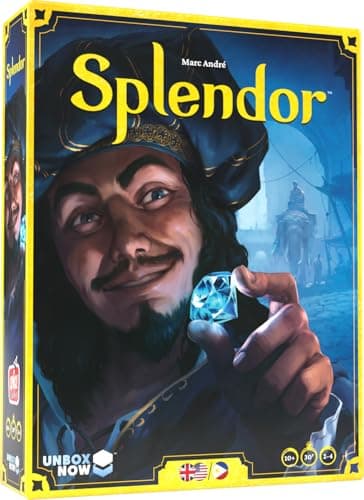
Take chips, buy cards, and the cards you bought make future cards cheaper. Thirty minutes by the publisher's clock, satisfying in the way a good puzzle is, and it has the nicest components of anything at this price.
#ad Price as of October 18, 2026, from Amazon. Prices change. How we make money.
What it actually is
A card-buying game. You collect gem chips, spend them on cards, and each card you own permanently reduces the cost of everything you buy afterwards.
What the publisher states
| Figure | Value | Source |
|---|---|---|
| Players | 2-4 | Space Cowboys, published game page |
| Age | 10+ | Space Cowboys, published game page |
| Length | 30 min | Space Cowboys, published game page |
Read from the publisher’s own page. Where a publisher does not state a figure, there is no row for it here.
What is good about it
- The weighted poker-style chips make it feel far more expensive than it is
- Almost no text on any component, so it crosses languages easily
- Thirty minutes and a clean finish - it never drags
What is not
- Quiet and solitary; players mostly work on their own tableau
- One card at the wrong moment can undo a plan, which some find unfair
- Caps at four
Who should skip it
Skip it for a group that wants to talk to each other. Splendor is a thinking game played in near-silence, and party-game people find it flat.
How it scored as a gift
- Easy to explain8.8
- Works for non-gamers8.6
- Group size range7.4
- Repeat plays8.8
- Feels like a gift9.4
Gift fit 8.7 / 10. That is our editorial judgment of how safe and well-aimed this is as a present, read off the published specifications - not a verdict on how good the game is, and not a test result. It is deliberately not marked up as a rating in this page’s structured data. How we pick.
Splendor Duel
Space Cowboys · A couple who found the original a bit polite
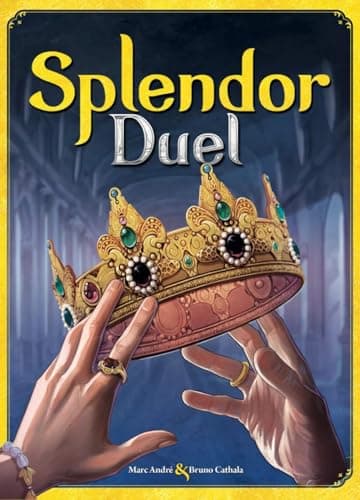
Splendor rebuilt for exactly two, with a shared board of gems you both draw from. It keeps the thirty-minute length and adds the direct competition the original was missing at two players.
#ad Price as of October 18, 2026, from Amazon. Prices change. How we make money.
What it actually is
A two-player card-buying game. You both take gems from the same small grid, so what you take is also what your opponent no longer gets.
What the publisher states
| Figure | Value | Source |
|---|---|---|
| Players | 2 | Space Cowboys, published game page |
| Age | 10+ | Space Cowboys, published game page |
| Length | 30 min | Space Cowboys, published game page |
Read from the publisher’s own page. Where a publisher does not state a figure, there is no row for it here.
What is good about it
- Every gem you take is one your opponent cannot, which the original lacked at two
- Three separate win conditions keep games from feeling identical
- Same thirty minutes as the original
What is not
- More rules than plain Splendor, so it is a worse first-ever board game
- Two players only
- Owners of Splendor may feel they are buying the same game twice
Who should skip it
Skip it as somebody's first board game. Plain Splendor or Jaipur teach faster and get to the fun sooner.
How it scored as a gift
- Easy to explain7.8
- Works for non-gamers7.8
- Group size range4.0
- Repeat plays9.2
- Feels like a gift8.8
Gift fit 8.5 / 10. That is our editorial judgment of how safe and well-aimed this is as a present, read off the published specifications - not a verdict on how good the game is, and not a test result. It is deliberately not marked up as a rating in this page’s structured data. How we pick.
How these were picked
We have not played these games and we do not pretend to have. What we did was read each publisher’s own page, take their stated player count, playing time and age band, check that every pick genuinely fits the constraint in this page’s title, confirm it is still being sold, and pull a live price rather than a remembered one. Every figure here names the publisher it came from, so you can check it yourself in about a minute.
How we pick sets out the full method, including what would change a ranking.
Questions people ask
+−What is the difference between Splendor and Splendor Duel?
Player count and design. Space Cowboys states 2-4 players for Splendor and 2 for Splendor Duel. Duel is not a variant: it adds a shared token board, pearls, privilege scrolls and three separate victory conditions, all so a two-player game has direct interaction in it.
+−Is Splendor Duel better than Splendor?
At two players, yes - it was designed for that count and the original was not. At three or four it is not a question, because Splendor Duel states 2 players and cannot be played by more.
+−Can you play Splendor Duel with 3 or 4 players?
No. Space Cowboys states 2 players for Splendor Duel. If three or four people will play, the original Splendor is the one to buy - the publisher states 2-4 for it.
+−Should I buy both Splendor and Splendor Duel?
Usually not. They scratch the same itch, so the one that matches your usual table gets played and the other does not. Buy one and put the difference towards a game of a different kind.
+−How long does Splendor Duel take?
Space Cowboys states 30 minutes, the same figure as the original. Turns are a single action each, so the half hour is mostly spent playing rather than waiting.