Head to head
7 Wonders Duel vs Splendor Duel
Two games designed for exactly two people, both half an hour, both with three separate paths to victory. They feel nothing alike once you are playing, and the difference decides which one suits your household.
By Scooter M. · Published · Last updated
How this page is funded: the buy links below are affiliate links. If you buy through one, we earn a commission at no extra cost to you. It does not change the order of the picks or what we say about them. Full disclosure.
Games we claim to have play-tested: 0. Every gift guide in this category implies a shelf of played games behind it. We do not have one, and we would rather say so. What we do instead is on this page: the publisher’s own player count, playing time and age band for every pick, cited to the publisher; a live price rather than a remembered one; and a plain answer on who should skip each game.
The short answer
Buy 7 Wonders Duel if you want the bigger, more dramatic game - Repos Production states 2 players, ages 10+, 30 minutes, and a game can end suddenly through military or scientific supremacy. Buy Splendor Duel (Space Cowboys: 2 players, ages 10+, 30 minutes) if you want something you can explain in three minutes and play most evenings. Duel is the better game; Splendor Duel is the one that gets played more often.
Side by side
| 7 Wonders Duel | Splendor Duel | |
|---|---|---|
| Players | 2 | 2 |
| Playing time | 30 min | 30 min |
| Age | 10+ | 10+ |
| Publisher | Repos Production | Space Cowboys |
| Designed for two? | Yes, from scratch | Yes, from scratch |
| Ways to win | Three | Three |
| Can the game end early? | Yes, on military or science | Yes, on a victory condition |
| Turn length | Take one card | Take one action |
The specifications are almost identical, which is why this comparison gets searched at all. Both publishers state exactly two players, both state 30 minutes, both state 10+, and both games were designed for two from the start rather than trimmed down from a bigger box. Everything that separates them is in what a turn feels like.
What 7 Wonders Duel actually is
Cards are laid out in an overlapping pyramid, some face down. You take an available card and either build it, sell it for coins, or spend it to build a stage of a wonder. Repos Production describes four development paths - military, science, commerce and civil - and three ways to win.
Two of those three ways end the game on the spot. Push the conflict pawn into your opponent’s capital with shields and you win immediately. Collect six different scientific symbols and you win immediately. If neither happens, the game runs to the end of Age III and the most victory points wins. That structure is the whole character of the game: you are never only building, you are also watching two disaster clocks.
What Splendor Duel actually is
On your turn you do one thing. Space Cowboys states the options plainly: collect up to three tokens from the shared board, buy a jewel card and resolve its effect, or reserve a card and take a gold token. Cards you buy make later cards cheaper, which is the engine that gives the original Splendor its name.
The two-player redesign adds the thing plain Splendor lacks with two people: the tokens come from one small shared grid, so every gem you take is a gem your opponent cannot have. Space Cowboys states three victory conditions - royal favors, privileges and prestige from gems and pearls - and reaching any one of them first ends the game.
The real difference is how a turn feels
In 7 Wonders Duel, a turn is a choice between cards somebody else has also been eyeing, and the consequences are often two or three turns away. It is a game of reading intentions. Beginners lose their first game to a science victory they did not see coming, and that moment is either the best thing about it or a reason to put it away.
In Splendor Duel, a turn is immediate and arithmetic: these gems, that card, that cost. The pressure is constant because the board is small, but the game rarely surprises you - it grinds rather than lunges. That makes it far easier to teach and far easier to start at nine in the evening.
7 Wonders Duel wins on
- Drama - two of its three victory conditions can end the game without warning
- Depth - four development paths means several genuinely different ways to play
- Replay value at a fixed count, because the pyramid layout changes every age
- It is the game more two-player households end up keeping long term
Splendor Duel wins on
- Teaching - one action per turn, and a new player is competitive in game one
- Pace - no card pyramid to set up, so it gets to the table on a weeknight
- Tension per minute - one shared grid of gems means every take is a denial
- Being the gentler introduction if neither of you plays board games much
Which to buy first
If neither of you plays board games, Splendor Duel. Three minutes of explaining, then you are playing, and nothing in it punishes a mistake you did not know you were making.
If one of you plays and the other is willing, 7 Wonders Duel. It is the more interesting game to come back to, and the sudden-victory conditions mean the experienced player cannot simply grind out a win.
If this is a gift and you know nothing else, 7 Wonders Duel - it is the better-known box, it presents better as a present, and it is the one we recommend most often on our two-player page.
What they cost
Both sit in the same band - a card game price rather than a big-box one - and the gap between them is small enough that it should not decide this. We never print a remembered price anywhere on this site: each button above shows a live figure when we hold one and says so plainly when we do not. If a budget is the fixed part of the decision, our picks under $30 start from the number instead.
The honest recommendation
For a household that will play a two-player game more than a few times a year, 7 Wonders Duel. It is the deeper game, the sudden endings keep it alive, and it stays interesting after a dozen plays.
For a household where the realistic outcome is a game twice a month after dinner, Splendor Duel, because the barrier to starting it is lower and that is what decides whether a box gets used. Our full 7 Wonders Duel review covers the first in more depth, and Splendor vs 7 Wonders Duel answers the other common version of this question - the one where the alternative is the original four-player Splendor rather than its two-player redesign.
What we would buy for this
Chosen from the same registry as our roundups, on the publisher's own figures and a live price.
7 Wonders Duel
Repos Production · A couple who want one properly good board game
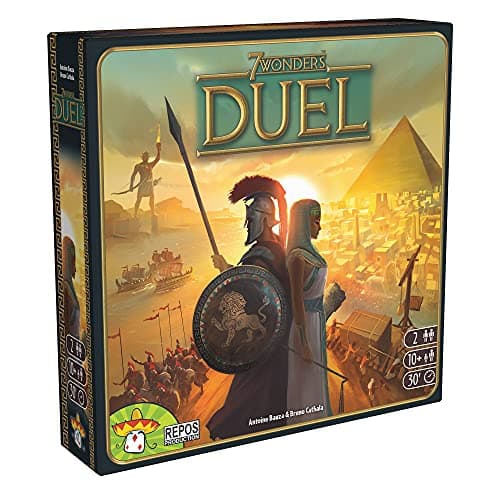
A full civilization game for exactly two people in thirty minutes. Repos built it for two rather than trimming a bigger game down, and it shows: nothing about it feels like a compromise.
#ad Price as of October 15, 2026, from Amazon. Prices change. How we make money.
What it actually is
You take cards from a shared pyramid to build a city, and there are three ways to win: points, military pressure, or science.
What the publisher states
| Figure | Value | Source |
|---|---|---|
| Players | 2 | Repos Production, published game page |
| Age | 10+ | Repos Production, published game page |
| Length | 30 min | Repos Production, published game page |
Read from the publisher’s own page. Where a publisher does not state a figure, there is no row for it here.
What is good about it
- Designed for two from the start, not adapted down from a larger game
- Three routes to victory, so two people can play very differently
- Thirty minutes makes it a weeknight game rather than an event
What is not
- Two players only - it cannot flex if a friend arrives
- The card symbols need a reference sheet for the first game or two
- The military track can end a game abruptly, which feels harsh at first
Who should skip it
Skip it if the household is ever three or more. It is strictly a two-player box, and there is no variant that changes that.
How it scored as a gift
- Easy to explain7.6
- Works for non-gamers8.0
- Group size range4.0
- Repeat plays9.6
- Feels like a gift9.2
Gift fit 9.2 / 10. That is our editorial judgment of how safe and well-aimed this is as a present, read off the published specifications - not a verdict on how good the game is, and not a test result. It is deliberately not marked up as a rating in this page’s structured data. How we pick.
Splendor Duel
Space Cowboys · A couple who found the original a bit polite
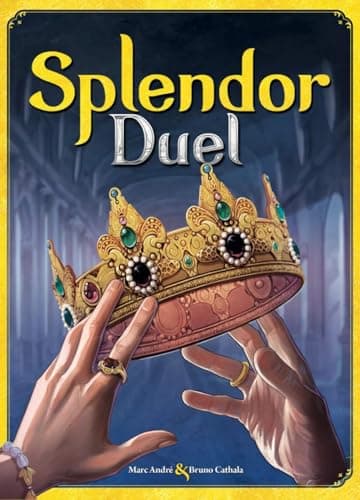
Splendor rebuilt for exactly two, with a shared board of gems you both draw from. It keeps the thirty-minute length and adds the direct competition the original was missing at two players.
#ad Price as of October 15, 2026, from Amazon. Prices change. How we make money.
What it actually is
A two-player card-buying game. You both take gems from the same small grid, so what you take is also what your opponent no longer gets.
What the publisher states
| Figure | Value | Source |
|---|---|---|
| Players | 2 | Space Cowboys, published game page |
| Age | 10+ | Space Cowboys, published game page |
| Length | 30 min | Space Cowboys, published game page |
Read from the publisher’s own page. Where a publisher does not state a figure, there is no row for it here.
What is good about it
- Every gem you take is one your opponent cannot, which the original lacked at two
- Three separate win conditions keep games from feeling identical
- Same thirty minutes as the original
What is not
- More rules than plain Splendor, so it is a worse first-ever board game
- Two players only
- Owners of Splendor may feel they are buying the same game twice
Who should skip it
Skip it as somebody's first board game. Plain Splendor or Jaipur teach faster and get to the fun sooner.
How it scored as a gift
- Easy to explain7.8
- Works for non-gamers7.8
- Group size range4.0
- Repeat plays9.2
- Feels like a gift8.8
Gift fit 8.5 / 10. That is our editorial judgment of how safe and well-aimed this is as a present, read off the published specifications - not a verdict on how good the game is, and not a test result. It is deliberately not marked up as a rating in this page’s structured data. How we pick.
How these were picked
We have not played these games and we do not pretend to have. What we did was read each publisher’s own page, take their stated player count, playing time and age band, check that every pick genuinely fits the constraint in this page’s title, confirm it is still being sold, and pull a live price rather than a remembered one. Every figure here names the publisher it came from, so you can check it yourself in about a minute.
How we pick sets out the full method, including what would change a ranking.
Questions people ask
+−Is 7 Wonders Duel or Splendor Duel better?
7 Wonders Duel is the deeper game and the one most two-player households keep. Splendor Duel is easier to teach and quicker to start, so it tends to get played more often. Both publishers state 2 players, ages 10+ and 30 minutes.
+−Are 7 Wonders Duel and Splendor Duel similar games?
Only on paper. Both are two-player-only card games of about 30 minutes with three ways to win. In play, 7 Wonders Duel is about reading what your opponent is collecting and racing two sudden-death conditions, while Splendor Duel is a tighter, more arithmetic fight over one shared grid of gems.
+−Which is easier to learn?
Splendor Duel. Space Cowboys describes a turn as one action - collect up to three tokens, buy a card, or reserve a card and take a gold token. 7 Wonders Duel asks a new player to understand four development paths and two instant-win conditions before the first game means much.
+−Do I need Splendor to play Splendor Duel?
No. Splendor Duel is a complete standalone game designed for exactly two players, not an expansion. The same is true of 7 Wonders Duel, which does not require 7 Wonders.
+−What age are they for?
Both publishers state 10+. That is a fair floor for either: neither needs much reading, but both need a player to hold a plan across several turns. Publisher-stated ages for everything we cover are on our age guide.