Game page
Skull
Four discs each and one bidding round. That is the entire game, and it produces more tension than almost anything else we cover - which is why it is the one to hand a skeptic.
By Scooter M. · Published · Last updated
How this page is funded: the buy links below are affiliate links. If you buy through one, we earn a commission at no extra cost to you. It does not change the order of the picks or what we say about them. Full disclosure.
Games we claim to have play-tested: 0. Every gift guide in this category implies a shelf of played games behind it. We do not have one, and we would rather say so. What we do instead is on this page: the publisher’s own player count, playing time and age band for every pick, cited to the publisher; a live price rather than a remembered one; and a plain answer on who should skip each game.
The short answer
Skull is the game to buy for somebody who says board games are boring. Space Cowboys states 3-6 players, 30 minutes. Each player has four discs - three flowers and one skull - and the whole game is placing them face down and then bidding on how many you can turn over without hitting a skull. There are no cards to read and no arithmetic. If the table is two people, this is the wrong game entirely.
What it actually is
Everybody gets a mat and four discs with identical backs: three flowers and one skull. You place discs face down on your mat in a stack, one at a time, around the table. At any point, instead of placing another disc, you can start bidding - announcing how many discs in total you believe you can turn over, starting with your own, without revealing a skull.
Bidding goes around and people either raise or drop out. The highest bidder has to flip that many discs, starting with their own stack and then choosing other people’s. Flip the number you promised with no skull and you win the round. Hit a skull and you lose a disc, permanently. Win twice and you win the game.
Space Cowboys lists six player sets of four discs each - three flower discs and one skull disc, with matching backs - plus a mat, a “Last Chance” disc and a rulebook. That is the whole box, and it is the whole game.
| Figure | Value | Source |
|---|---|---|
| Players | 3-6 | Space Cowboys, published game page |
| Age | 10+ | Space Cowboys, published game page |
| Length | 30 min | Space Cowboys, published game page |
| Contents | Six sets of four discs (three flowers, one skull), a mat each, a Last Chance disc, a rulebook | Space Cowboys, published game page |
Who it is for
- Best for converting a skeptic. Nothing to learn, nothing to read, and the tension arrives in round one.
- Best for a mixed-language table. There is not a single word anywhere in play.
- Best for a group of five or six. It gets better with more people, which is unusual.
- Best-looking cheap game we cover. The discs are substantial objects, so it presents as a real gift rather than a card game.
Why nothing happening is the point
Mechanically, Skull does almost nothing. There is no engine, no scoring track and no cards with abilities. Every single thing that happens in a game of Skull happens in somebody’s head: whether the person who just bid four is confident or desperate, whether the quiet one at the end of the table put their skull down first this time because they always do, whether you can get away with bidding high to make somebody else over-commit.
That is why it works on people who do not like board games. There is no barrier of rules between them and the interesting part, because there are no rules to speak of. It is also why some people bounce off it completely - if you want a system to solve, this is a half-hour of eye contact instead.
What is good about it
- Probably the shortest rulebook of any game on this site - it explains in under a minute
- No reading, no arithmetic and no cards to interpret during play
- Handsome, chunky components, so it survives being given to an adult as a present
- Better at five and six players than at three, which is the opposite of most games we cover
- Thirty stated minutes, and it can be stopped and restarted between rounds without anybody losing the thread
- Works at a table that is also eating or drinking - nothing needs to be laid out
What is not
- Almost nothing happens mechanically - the game is entirely people reading people, and that is not for everyone
- Needs at least three by the publisher’s own floor, and is noticeably thin at exactly three
- Players who dislike being bluffed, or being wrong in front of other people, will dislike this specifically
- Losing a disc is permanent within a game, so a bad early round leaves somebody with less to do for the rest of it
- It is quiet. If you want the room to be loud, this is not the box - that is The Chameleon or Herd Mentality
Who should skip it
A household of two. Space Cowboys states a floor of three, and the game needs more than that to breathe - the bluffing only works when the bidder has several people to misread. Our two-player page is the right shelf instead.
Anybody who wants to see progress. There is no board filling up and no score creeping along. Some people find that elegant and some find it empty. Splendor is the opposite instinct, and the same price.
A table with children under ten. The publisher states 10+, and the game asks for a poker face that most younger children cannot hold - which they find frustrating rather than funny.
How it compares to the other bluffing and party games we cover
Against The Chameleon (Big Potato: 3-8 players, 14+, 15 minutes), Skull is quieter, slower and more tense, and it starts at a lower stated age. The Chameleon is the one that produces shouting; Skull is the one that produces silence.
Against Love Letter (Z-Man Games: 2-6 players, 10+, 20 minutes), the other tiny deduction game we cover, Love Letter is cheaper and plays at two; Skull is better with a crowd and better as an object.
Against Codenames (Czech Games Edition: 4-8 players, 10+, 15 minutes), Codenames is the safer gift for a family and Skull is the better one for a group of adults who have played Codenames a hundred times.
More of the same shelf is on our party games page and our picks for non-gamers, where the no-rules argument matters most.
What it costs
It is cheap for what arrives - a small box of substantial components rather than a deck of cards. We never print a remembered price anywhere on this site: the button above shows a live figure when we hold one and says so plainly when we do not. Our picks under $20 put it in context.
What we would buy for this
Chosen from the same registry as our roundups, on the publisher's own figures and a live price.
Skull
Space Cowboys · Proving to a skeptic that a board game can be tense
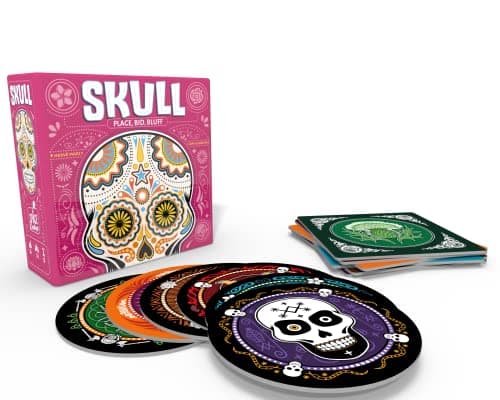
Four cards each and a bidding round. That is the whole game, and it produces more tension than boxes ten times the size. A very good gift for someone who says they do not like board games.
#ad Price as of October 18, 2026, from Amazon. Prices change. How we make money.
What it actually is
A bluffing game. You place discs face down, then bid on how many you can turn over without hitting a skull - including your own.
What the publisher states
| Figure | Value | Source |
|---|---|---|
| Players | 3-6 | Space Cowboys, published game page |
| Age | 10+ | Space Cowboys, published game page |
| Length | 30 min | Space Cowboys, published game page |
Read from the publisher’s own page. Where a publisher does not state a figure, there is no row for it here.
What is good about it
- Probably the shortest rulebook of any game on this site
- No reading, no arithmetic, no cards to interpret
- Handsome components, so it presents well as a gift
What is not
- Almost nothing happens mechanically - the game is entirely people reading people
- Needs at least three, and is much better at five
- Players who dislike being bluffed will dislike this specifically
Who should skip it
Skip it for two people; the publisher's floor is three and it really needs more than that to breathe.
How it scored as a gift
- Easy to explain9.6
- Works for non-gamers8.8
- Group size range7.4
- Repeat plays8.2
- Feels like a gift8.4
Gift fit 7.9 / 10. That is our editorial judgment of how safe and well-aimed this is as a present, read off the published specifications - not a verdict on how good the game is, and not a test result. It is deliberately not marked up as a rating in this page’s structured data. How we pick.
How these were picked
We have not played these games and we do not pretend to have. What we did was read each publisher’s own page, take their stated player count, playing time and age band, check that every pick genuinely fits the constraint in this page’s title, confirm it is still being sold, and pull a live price rather than a remembered one. Every figure here names the publisher it came from, so you can check it yourself in about a minute.
How we pick sets out the full method, including what would change a ranking.
Questions people ask
+−How many players do you need for Skull?
Space Cowboys states 3-6 players. Three works but is thin; five or six is where the bluffing has enough people in it to be genuinely hard to read.
+−How long does a game of Skull take?
Thirty minutes by the publisher’s figure. Individual rounds are only a few minutes each, so it can be stopped and picked up again without anybody losing track.
+−What is in the Skull box?
Space Cowboys lists six player sets of four discs each - three flower discs and one skull disc, with matching backs - plus a mat, a Last Chance disc and a rulebook. There are no cards and no board.
+−Is Skull good for people who do not play board games?
It is one of the best we cover for that. There is nothing to read, nothing to count and one rule, so a new player is competitive in their first round - which is rarely true of a game with an actual rulebook.
+−Can you play Skull with 2 players?
Not as published - the publisher’s stated floor is three. Bluffing needs an audience, and at two there is only one person to read and no reason to be subtle about it.