Game page
Sushi Go!
A tin of 108 cards that teaches card drafting in about ninety seconds. It is the cheapest thing on this site that a household will still be playing in five years.
By Scooter M. · Published · Last updated
How this page is funded: the buy links below are affiliate links. If you buy through one, we earn a commission at no extra cost to you. It does not change the order of the picks or what we say about them. Full disclosure.
Games we claim to have play-tested: 0. Every gift guide in this category implies a shelf of played games behind it. We do not have one, and we would rather say so. What we do instead is on this page: the publisher’s own player count, playing time and age band for every pick, cited to the publisher; a live price rather than a remembered one; and a plain answer on who should skip each game.
The short answer
Sushi Go! is the best cheap board game gift we cover, and it is for a household of two to five who want something that finishes. Gamewright states 2-5 players, ages 8+, 15 minutes, for 108 cards in a tin. Everyone picks one card at the same moment and passes the rest, so nobody waits for a turn. If six or more people play regularly, buy Sushi Go Party! instead.
What it actually is
You are dealt a hand of cards. Everybody chooses one card from that hand at the same time, reveals it, then passes what is left to the player beside them. You do that until the cards run out, three times, and then you count up what you collected.
That is card drafting, and Sushi Go! is the game that made it explicable to people who do not play board games. Gamewright’s own description is blunter and better than ours: “Pass the sushi!” You are grabbing “the best combination of sushi dishes as they whiz by” - maki rolls that score for having the most of them, sashimi that is worth nothing at all unless you collect three, wasabi that triples the next nigiri you take, and pudding that stings you at the end of the game if you ignored it.
The publisher says the inventor, Phil Walker-Harding, created “a unique and immediately approachable take on card drafting”, and approachable is the word doing the work. There is no board, nothing to set up beyond dealing, and nothing to read on a card beyond its picture and a number.
| Figure | Value | Source |
|---|---|---|
| Players | 2-5 | Gamewright, published product page |
| Age | 8+ | Gamewright, published product page |
| Playing time | 15 min | Gamewright, published product page |
| Contents | 108 cards and a Rules of Play sheet | Gamewright, published product page |
Who it is for
- Best for a household that says it has no time. Fifteen minutes by the publisher’s own clock, and a setup that is literally shuffling.
- Best for a table with one adult and one child. A stated floor of two and an age of 8+, with no reading required once somebody has explained the symbols.
- Best as an add-on present. It costs less than a cinema ticket and still looks like a real gift, because the tin is a tin rather than a paper wallet.
- Best first drafting game. If somebody liked this, they will like 7 Wonders, Splendor and half this site.
Why simultaneous play matters more than it sounds
Almost every complaint a non-gamer has about board games is really a complaint about waiting. You sit, somebody else thinks, nothing happens, and twenty minutes later it is your turn again. Sushi Go! removes that completely: every player chooses at the same moment, every round, so the game moves at the speed of the slowest decision rather than the sum of everybody’s.
That is also why it works at a table that is doing something else. People eat during it, talk over it and still finish, which is a rare property and the reason it turns up on our dinner party page as well as here.
What is good about it
- Fifteen stated minutes, and the setup is dealing - so the real commitment is about seventeen
- Nobody waits for a turn, which keeps children and bored adults in the game
- The scoring is visible on the cards, so a new player can see why they are losing and fix it in round two
- Cheapest real game on this site, by some distance, and a tin survives a bag
- A stated floor of two, and it genuinely plays there - there is a variant hand for it
- Illustrated rather than written, so there is no reading during play
What is not
- It is small. As the only present for an occasion that expects a box, it can underwhelm when unwrapped
- The fixed card mix means every game is drawn from the same deck - the variety comes from the people, not the box
- Five is the stated ceiling, and a sixth person turning up ends the game rather than joining it
- The pudding scoring at the end catches new players out, which is funny once and irritating the second time
- Three rounds is sometimes two rounds too few - groups ask to play again
Who should skip it
Anybody buying the main present. This is a tin of cards and it looks like one in the hand. It is a superb thing to add to a gift and a thin thing to be the gift, unless the recipient has specifically asked for something small.
A household that always has six people at the table. Gamewright states five as the maximum. Herd Mentality and Codenames scale to a crowd; our six-player page has the rest.
Someone who wants a game with a board. Part of what people are buying when they buy a board game is the object - a board, pieces, something that occupies the table. Sushi Go! has none of that on purpose. If that is the brief, Ticket to Ride is the safe answer at the other end of the shelf.
How it compares to the other card games we cover
Against Love Letter (Z-Man Games: 2-6 players, 10+, 20 minutes), Sushi Go! is the better game for a family table and Love Letter is the better one for a pocket - sixteen cards against a hundred and eight.
Against Exploding Kittens (Exploding Kittens: 2-5 players, 7+, 15 minutes), Sushi Go! is the one with decisions in it. Exploding Kittens is the more recognizable box and mostly luck; Sushi Go! is the one somebody will still choose in a year.
Against Point Salad (Alderac Entertainment Group: 2-6 players, 15-30 minutes), which is the same drafting idea with a much larger set of scoring rules, Sushi Go! is simpler and shorter and Point Salad has more in it for a table that has already worn this one out.
The rest of the shelf is on our family card games page and our short games page, where this is the number two pick.
What it costs
It is the cheapest thing we recommend, and that is the main argument for buying it without thinking about it very hard. We never print a remembered price anywhere on this site: the button above shows a live figure when we hold one and says so plainly when we do not. Our picks under $20 put it in context against everything else at that money.
What we would buy for this
Chosen from the same registry as our roundups, on the publisher's own figures and a live price.
Sushi Go!
Gamewright · A small, cheap gift that is actually good
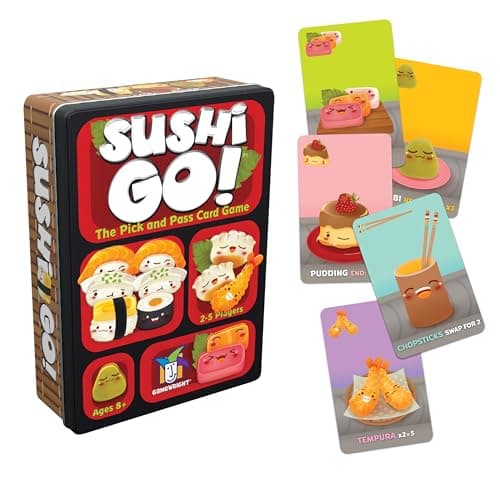
A tin of cards, fifteen minutes, and one of the best value-for-money gifts in the whole category. You pass hands of cards around and try to collect the sets that score well together.
#ad Price as of October 18, 2026, from Amazon. Prices change. How we make money.
What it actually is
A card game where you pick one card from your hand, pass the rest to your neighbor, and repeat - so every hand you see has already been picked over.
What the publisher states
| Figure | Value | Source |
|---|---|---|
| Players | 2-5 | Gamewright, published product page |
| Age | 8+ | Gamewright, published product page |
| Length | 15 min | Gamewright, published product page |
Read from the publisher’s own page. Where a publisher does not state a figure, there is no row for it here.
What is good about it
- Fits in a coat pocket, so it travels and it fits a stocking
- Fifteen minutes means a household plays it three times in a sitting
- Cheap enough to give alongside something else
What is not
- Caps at five - Sushi Go Party! is the version that seats eight
- Scoring is fiddly the first time through
- Almost too small to feel like a main present on its own
Who should skip it
Skip it as a sole main gift for an adult - it reads as a stocking filler no matter how good it is. Give it alongside something larger.
How it scored as a gift
- Easy to explain9.2
- Works for non-gamers9.2
- Group size range7.8
- Repeat plays8.6
- Feels like a gift7.4
Gift fit 8.9 / 10. That is our editorial judgment of how safe and well-aimed this is as a present, read off the published specifications - not a verdict on how good the game is, and not a test result. It is deliberately not marked up as a rating in this page’s structured data. How we pick.
How these were picked
We have not played these games and we do not pretend to have. What we did was read each publisher’s own page, take their stated player count, playing time and age band, check that every pick genuinely fits the constraint in this page’s title, confirm it is still being sold, and pull a live price rather than a remembered one. Every figure here names the publisher it came from, so you can check it yourself in about a minute.
How we pick sets out the full method, including what would change a ranking.
Questions people ask
+−How many players is Sushi Go for?
Gamewright states 2-5 players. It plays well at the bottom of that range as well as the top, which is unusual. If you need six or more, Sushi Go Party! states 2-8.
+−How long does Sushi Go take to play?
Fifteen minutes by Gamewright’s own figure, plus about a minute to shuffle and deal. Most groups immediately play a second game, so budget half an hour for the evening rather than for the game.
+−What age is Sushi Go suitable for?
Gamewright states 8+. The age is about understanding the scoring symbols rather than reading - the cards are illustrated. Younger children play happily on an adult’s team, because everyone chooses at the same time and nobody is exposed.
+−Is Sushi Go worth buying?
For the money, it is the easiest yes on this site. You get 108 cards, a fifteen-minute game that two to five people can play, and a tin that survives being carried around. The honest caveat is size: as the whole present it can look slight, so pair it with something.
+−Is Sushi Go good for 2 players?
Yes - two is inside Gamewright’s stated range and the game is built to handle it. It is a faster, sharper game at two than at five, with less chaos in what gets passed to you.
+−What is the difference between Sushi Go and Sushi Go Party?
Capacity and variety. Gamewright states 2-5 players and 15 minutes for Sushi Go!, and 2-8 players and 30 minutes for Sushi Go Party!, which adds a board and a larger set of cards you choose from before each game. The Party box includes the original’s cards, so there is no reason to own both.