Roundup
The Best Board Games for 3 Year Olds
Three is the age where a game has to work with no reading, almost no counting and about ten minutes of attention. These six are sorted by the publisher's own stated age band, not by what the box art suggests.
By Scooter M. · Published · Last updated
How this page is funded: the buy links below are affiliate links. If you buy through one, we earn a commission at no extra cost to you. It does not change the order of the picks or what we say about them. Full disclosure.
Games we claim to have play-tested: 0. Every gift guide in this category implies a shelf of played games behind it. We do not have one, and we would rather say so. What we do instead is on this page: the publisher’s own player count, playing time and age band for every pick, cited to the publisher; a live price rather than a remembered one; and a plain answer on who should skip each game.
The short answer
For a three-year-old, buy Orchard - HABA states 1 to 8 players, ages 3 to 6 years, 10 to 15 minutes, and it is cooperative, so the whole table picks the fruit before the raven gets there and nobody loses to anybody. If the child has only just turned three, Here, Fishy, Fishy! (HABA: 1-4 players, ages 2 to 3 years, 5 to 10 minutes) is the shorter, simpler starting point.
Three is the age at which a board game becomes possible but not yet reliable. A three-year-old can hold a piece, roll a die, recognize a color and take a turn when reminded. What they generally cannot do is read a word, count past three or four, wait through two other people’s turns without wandering off, or lose a race they cared about without the evening ending.
That is a narrow window, and it is why the honest list at this age is short. Every pick below is chosen on the publisher’s own stated age band - the figure printed by the company that made the game - rather than on a shop shelf label or an age we guessed. Five of the six state a floor of 3 or below. The sixth is a year above and is on the page for a specific reason we explain below.
| Game | Stated age | Players | Time | Publisher |
|---|---|---|---|---|
| My Very First Games - Here, Fishy, Fishy! | 2-3 years | 1-4 | 5-10 min | HABA |
| My Very First Games - First Orchard | 2-3 years | 1-4 | 10 min | HABA |
| My Very First Games - Animal Upon Animal Junior | 2-3 years | 1-4 | 10 min | HABA |
| Orchard | 3-6 years | 1-8 | 10-15 min | HABA |
| Unicorn Glitterluck - Cloud Crystals | 3+ | 2-4 | 10 min | HABA |
| My First Carcassonne | 4+ | 2-4 | 30 min | Z-Man Games |
How these six were chosen
Three tests, in this order. First, the publisher has to state an age band we can read on their own page, because at three the difference between a game rated for two-year-olds and one rated for five-year-olds is the difference between a present that gets played and one that gets put on a shelf. Second, nothing can require reading or counting past about three. Third, it has to be finished before the child is - which in practice means ten minutes.
What we did not use is a recommendation. We have not play-tested these games; what we do instead, and why, is on how we pick. Every player count, age band and playing time above and below was read from the publisher’s own product page and is attributed to them in the table on each pick.
Why five of these six are made by one company
This is the finding rather than a preference, and it is worth saying plainly: HABA is one of the very few publishers that prints a 2-to-3-year age band, a player count and a playing time on the games it sells in the US. Most of the toys marketed at this age publish an age and nothing else, and several of the best-known ones publish an age that does not match the box they sell on Amazon.
We are not paid by HABA and there is no arrangement of any kind. If a publisher we could read published a better three-year-old game tomorrow it would be on this page the week after. The consequence for a buyer is real, though: at this age the games with full published figures are wooden, German-made and priced accordingly, and the cheaper mass-market boxes are the ones we cannot quote figures for.
Cooperative or competitive at three
At three this decides whether the box gets opened twice. A three-year-old who loses a race they were enjoying can be done with that game for months, and there is no adult diplomacy that fixes it in the moment - they are not being unreasonable, they are three.
If losing is a problem, buy Orchard. HABA states 1 to 8 players and 10 to 15 minutes, and everybody at the table is trying to pick the fruit before the raven reaches the orchard, so an adult can play properly without beating a child. Animal Upon Animal Junior includes a cooperative game in the box as one of its three, which makes it the other safe answer.
If they want to win something, Unicorn Glitterluck is a ten-minute dice race with a genuine winner, and at HABA’s stated 3+ it is one of the earliest games a child can win fairly rather than by an adult playing badly on purpose. There are more games built on the everybody-versus-the-board idea on our cooperative games page, though most of them start at five or later.
Ten minutes is the real specification
The stated times on this page run from five minutes to fifteen, and that band is not a coincidence. A three-year-old’s attention for a structured activity with other people is short and it does not improve because the game is good. A ten-minute game played four times in a row is a success. A thirty-minute game abandoned at the halfway point is the same box, badly chosen.
This is also why My First Carcassonne sits last rather than first. Z-Man states 30 minutes for it, which is three times the length of everything above it, and the honest answer is that most three-year-olds will place tiles happily for ten minutes and then go and do something else. It is a genuinely better game, and it is the right present for a child who turns four in the next few months - which is why it is our number one on the page for four-year-olds. The published times for everything we cover are collected on our playing-time guide.
If there is an older or younger child in the house
Three of these six state a floor of two years, which matters more than it sounds. A household with a three-year-old and a toddler can put both children at Here, Fishy, Fishy! or First Orchard rather than running two separate activities, and HABA states 1 to 4 players for both, so an adult can join without anyone sitting out.
Going the other way is harder. A six-year-old will not play a game rated 2 to 3 years twice, with one exception: Orchard states a band of 3 to 6 years and seats up to eight, so it genuinely works with an older sibling at the table. If the older child is the one you are shopping for, start on our kids page instead, and our age guide explains what the printed floors actually mean.
What to spend
Games for this age split into two price bands and the split is about material rather than quality of play. The wooden games are made in Germany and cost roughly what a full-size family game costs; the mass-market cardboard-and-plastic boxes cost a fraction of that. We never print a remembered price anywhere on this site - each pick’s button shows a live figure when we hold one and says so plainly when we do not.
If the budget is the fixed part of the decision, it is worth knowing that the cheapest option at three is usually a second-hand copy of one of these rather than a new copy of something worse. Our picks under $20 start from the number instead, though most of that page is aimed at older children and adults.
Quick picks
Ranked on how well each one fits the job in this page’s title, using the publisher’s own player count, playing time and age band. Tap any row for the full write-up, including who should skip it.
| # | Product | Best for | Gift fit | Price |
|---|---|---|---|---|
| 1 | 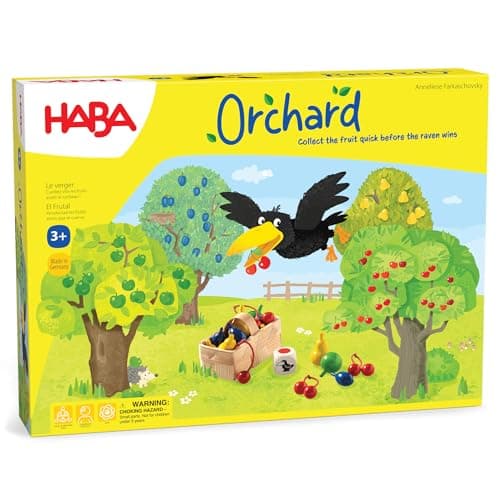 Orchard1-8 players · 10-15 min · 3+ Orchard1-8 players · 10-15 min · 3+ | Best overall for a three-year-old | 8.3 | $44.99 - View on Amazon |
| 2 | 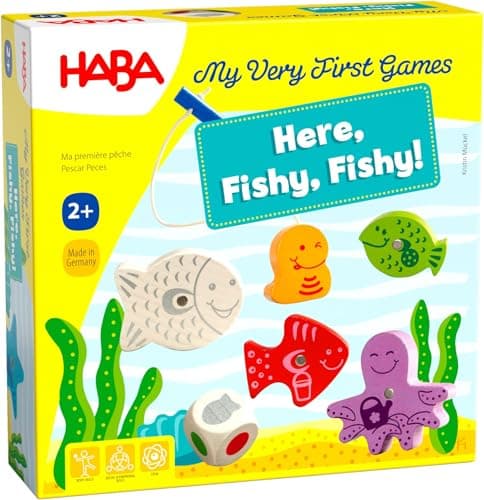 My Very First Games - Here, Fishy, Fishy!1-4 players · 5-10 min · 2+ My Very First Games - Here, Fishy, Fishy!1-4 players · 5-10 min · 2+ | Best for a child who has just turned three | 8.0 | $29.99 - View on Amazon |
| 3 | 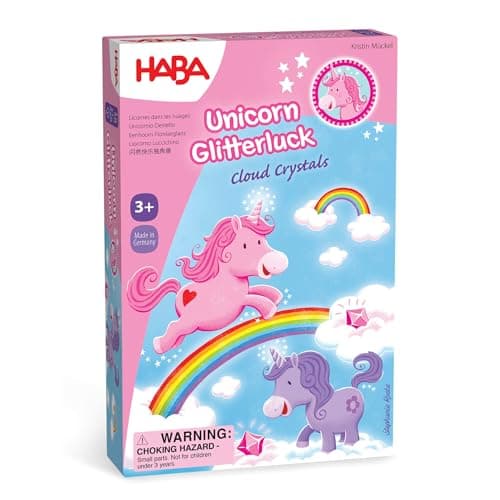 Unicorn Glitterluck - Cloud Crystals2-4 players · 10 min · 3+ Unicorn Glitterluck - Cloud Crystals2-4 players · 10 min · 3+ | Best first game they can win | 8.0 | $19.99 - View on Amazon |
| 4 | 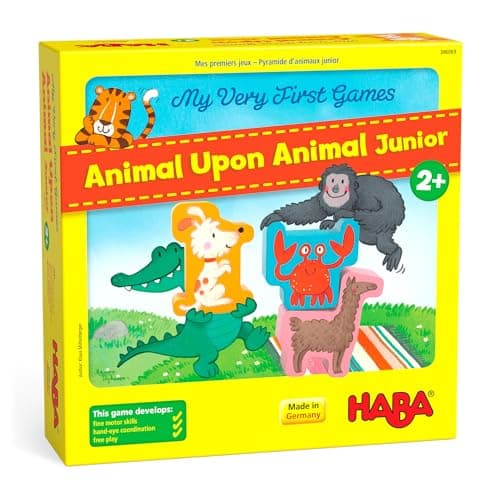 My Very First Games - Animal Upon Animal Junior1-4 players · 10 min · 2+ My Very First Games - Animal Upon Animal Junior1-4 players · 10 min · 2+ | Best for a child who would rather build | 8.1 | $29.99 - View on Amazon |
| 5 | 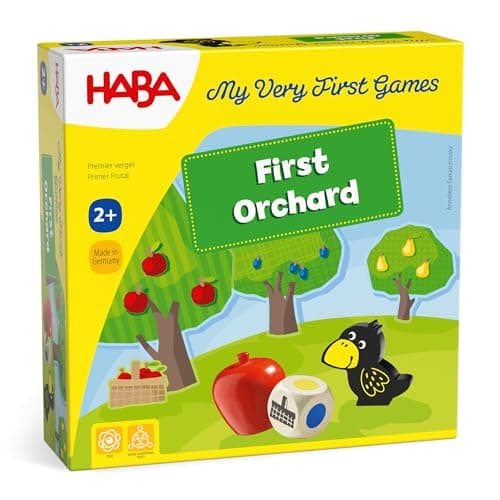 My Very First Games - First Orchard1-4 players · 10 min · 2+ My Very First Games - First Orchard1-4 players · 10 min · 2+ | Best if a two-year-old is at the table too | 7.9 | $29.99 - View on Amazon |
| 6 | 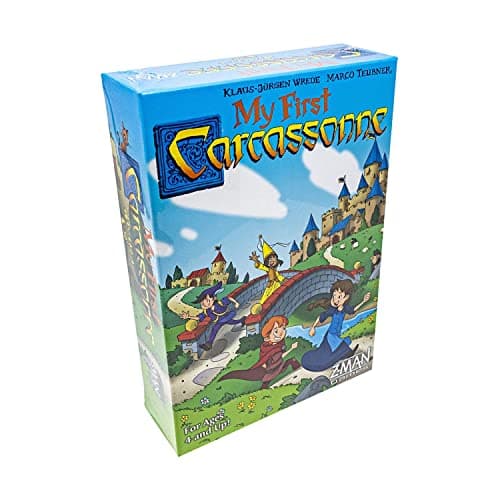 My First Carcassonne2-4 players · 30 min · 4+ My First Carcassonne2-4 players · 30 min · 4+ | Best for next year | 8.6 | $42.98 - View on Amazon |
#1 - Best overall for a three-year-old
Orchard
HABA · A four-year-old who is not ready to lose yet
The cooperative fruit-picking game HABA has been selling for decades, in the version rated for 3 to 6 year olds. HABA states 1 to 8 players and 10 to 15 minutes, and everyone plays on the same side against the raven - so a four-year-old cannot lose to a grown-up.
#ad Price as of October 15, 2026, from Amazon. Prices change. How we make money.
What it actually is
A cooperative dice game. You roll a color die and pick that fruit from the trees; the table is trying to harvest the whole orchard before the raven gets there first.
Does it fit this page?
HABA states 1-8 players, ages 3 to 6 years, 10-15 minutes. Cooperative, so the table plays against the raven rather than against a three-year-old, and the stated band runs to six - this is the one that is still in use in two years.
What the publisher states
| Figure | Value | Source |
|---|---|---|
| Players | 1-8 | HABA USA, published product page |
| Age | 3-6 years | HABA USA, published product page |
| Playing time | 10-15 min | HABA USA, published product page |
Read from the publisher’s own page. Where a publisher does not state a figure, there is no row for it here.
What is good about it
- Cooperative, so nobody is beaten by an older sibling or a parent
- A stated ceiling of eight players, which is remarkable at this age
- Ten to fifteen minutes, which matches a four-year-old's actual attention span
What is not
- There is no decision in it - you roll and you take the matching fruit
- Adults get nothing out of it beyond the company
- Children move past it at about six, by the publisher's own range
Who should skip it
Skip it for a child who is already asking to win. This is a game about picking fruit together, and it does not become a contest at any point.
How it scored as a gift
- Easy to explain9.8
- Works for non-gamers9.6
- Group size range8.4
- Repeat plays7.4
- Feels like a gift8.4
Gift fit 8.3 / 10. That is our editorial judgment of how safe and well-aimed this is as a present, read off the published specifications - not a verdict on how good the game is, and not a test result. It is deliberately not marked up as a rating in this page’s structured data. How we pick.
#2 - Best for a child who has just turned three
My Very First Games - Here, Fishy, Fishy!
HABA · A child who has just turned three and has never played a game
A magnetic fishing rod, six wooden sea creatures and a color die. HABA states 1 to 4 players, ages 2 to 3 years, 5 to 10 minutes - which is the shortest stated game we cover, and at three that is the point rather than a shortcoming.
#ad Price as of October 15, 2026, from Amazon. Prices change. How we make money.
What it actually is
A first game. A child rolls a color die, then uses a magnetic rod to fish out the wooden sea creature that matches; HABA's own description has it teaching turn-taking, color recognition and hand-eye coordination.
Does it fit this page?
HABA states 1-4 players, ages 2 to 3 years, 5-10 minutes. Roll a color, fish out the matching wooden sea creature - the shortest stated game on this page, which at three is the feature.
What the publisher states
| Figure | Value | Source |
|---|---|---|
| Players | 1-4 | HABA USA, published product page |
| Age | 2-3 years | HABA USA, published product page |
| Playing time | 5-10 min | HABA USA, published product page |
Read from the publisher’s own page. Where a publisher does not state a figure, there is no row for it here.
What is good about it
- Five to ten minutes by the publisher's own clock, which is about the length of a three-year-old's attention
- The fishing rod does the work, so a child who cannot yet plan a turn still has something to do
- The wooden pieces survive being used as ordinary toys between games, which they will be
What is not
- There is nothing to decide - the die says which fish, and that is the whole turn
- A confident four-year-old will be finished with it inside a month
- It costs what a full-size family game costs, for six wooden fish and a rod
Who should skip it
Skip it if the child is closer to four than three. The die-and-match loop is aimed squarely at two- and three-year-olds and it does not stretch.
How it scored as a gift
- Easy to explain9.4
- Works for non-gamers9.2
- Group size range7.4
- Repeat plays6.8
- Feels like a gift8.0
Gift fit 8.0 / 10. That is our editorial judgment of how safe and well-aimed this is as a present, read off the published specifications - not a verdict on how good the game is, and not a test result. It is deliberately not marked up as a rating in this page’s structured data. How we pick.
#3 - Best first game they can win
Unicorn Glitterluck - Cloud Crystals
HABA · A four-year-old who wants to actually win something
A dice race along a cloud path, collecting glittering crystals on the way to the sun. HABA states 2 to 4 players, ages 3 and up, 10 minutes - the shortest competitive game we cover for this age, and the first one many children win on their own.
#ad Price as of October 15, 2026, from Amazon. Prices change. How we make money.
What it actually is
A racing game. Each child takes a unicorn, rolls a die to move along the cloud path, and picks up cloud crystals on the way; whoever reaches the sun cloud with the most crystals wins.
Does it fit this page?
HABA states 2-4 players, ages 3 and up, 10 minutes. A dice race with a real winner at the end, short enough that losing one is survivable and quick enough to play again straight away.
What the publisher states
| Figure | Value | Source |
|---|---|---|
| Players | 2-4 | HABA USA, published product page |
| Age | 3+ | HABA USA, published product page |
| Playing time | 10 min | HABA USA, published product page |
Read from the publisher’s own page. Where a publisher does not state a figure, there is no row for it here.
What is good about it
- Competitive at a stated age of 3, which is unusually early for a game a child can win fairly
- Ten minutes, so it survives being played three times in a row
- The crystals are the reason children ask for it again
What is not
- The outcome is entirely the die - there is no decision to make
- The crystals are small pieces, which matters in a house with a toddler
- Heavily themed, and not every child wants unicorns
Who should skip it
Skip it if a younger sibling still puts things in their mouth, and skip it for a child who takes losing badly - this one has a winner and a loser in ten minutes flat.
How it scored as a gift
- Easy to explain9.8
- Works for non-gamers9.4
- Group size range6.8
- Repeat plays7.6
- Feels like a gift8.2
Gift fit 8.0 / 10. That is our editorial judgment of how safe and well-aimed this is as a present, read off the published specifications - not a verdict on how good the game is, and not a test result. It is deliberately not marked up as a rating in this page’s structured data. How we pick.
#4 - Best for a child who would rather build
My Very First Games - Animal Upon Animal Junior
HABA · A three-year-old who would rather build than take a turn
The junior version of HABA's wooden stacking game, cut down to a size a three-year-old can actually balance. HABA states 1 to 4 players, ages 2 to 3 years, 10 minutes, and three games in the box - one of them cooperative.
#ad Price as of October 15, 2026, from Amazon. Prices change. How we make money.
What it actually is
A dexterity game. Children stack chunky wooden animals on top of each other, with a die deciding which animal goes on next; in one of the three included games the table works together to beat the crab.
Does it fit this page?
HABA states 1-4 players, ages 2 to 3 years, 10 minutes. Balancing chunky wooden animals is a skill a three-year-old already has, so they are competing rather than being carried.
What the publisher states
| Figure | Value | Source |
|---|---|---|
| Players | 1-4 | HABA USA, published product page |
| Age | 2-3 years | HABA USA, published product page |
| Playing time | 10 min | HABA USA, published product page |
Read from the publisher’s own page. Where a publisher does not state a figure, there is no row for it here.
What is good about it
- Balancing is a skill a three-year-old already has, so they are not being carried by an adult
- Three games in one box, including a cooperative one for a child who minds losing
- The animals work as blocks when nobody wants to play a game
What is not
- The tower falling is the whole game, and some three-year-olds find that upsetting rather than funny
- No reading and no counting, which also means nothing to grow into
- The full-size Animal Upon Animal is cheaper and lasts years longer, if the child is nearly four
Who should skip it
Skip it if the child is already four - buy the full-size Animal Upon Animal instead, which HABA rates 4+ and which an adult can enjoy.
How it scored as a gift
- Easy to explain9.2
- Works for non-gamers9.0
- Group size range7.4
- Repeat plays7.4
- Feels like a gift8.2
Gift fit 8.1 / 10. That is our editorial judgment of how safe and well-aimed this is as a present, read off the published specifications - not a verdict on how good the game is, and not a test result. It is deliberately not marked up as a rating in this page’s structured data. How we pick.
#5 - Best if a two-year-old is at the table too
My Very First Games - First Orchard
HABA · The two-year-old at the same table as a four-year-old
The same fruit-picking idea cut down for the very young: HABA states 1 to 4 players, 10 minutes, and an age range of 2 to 3 years. The pieces are large wooden fruit, which is the point at this age.
#ad Price as of October 15, 2026, from Amazon. Prices change. How we make money.
What it actually is
A cooperative first game. You roll a chunky color die and take the matching wooden fruit off its tree, all trying to empty the orchard before the raven arrives.
Does it fit this page?
HABA states 1-4 players, ages 2 to 3 years, 10 minutes, with fruit big enough for a toddler's hands - the pick for a household where the three-year-old has a much younger sibling.
What the publisher states
| Figure | Value | Source |
|---|---|---|
| Players | 1-4 | HABA USA, published product page |
| Age | 2-3 years | HABA USA, published product page |
| Playing time | 10 min | HABA USA, published product page |
Read from the publisher’s own page. Where a publisher does not state a figure, there is no row for it here.
What is good about it
- The lowest publisher-stated age of anything we cover, at 2 to 3 years
- Large wooden fruit rather than card tokens, which suits hands that age
- Cooperative, so a toddler plays alongside an older sibling without being beaten
What is not
- HABA's own stated range stops at 3, so a four-year-old will outgrow it quickly
- There is no game in it beyond matching a color
- Caps at four players
Who should skip it
Skip it for a four-year-old as the main present - HABA rates it 2 to 3, and at four it is already a year behind. Buy the full Orchard instead.
How it scored as a gift
- Easy to explain10.0
- Works for non-gamers9.8
- Group size range6.8
- Repeat plays6.8
- Feels like a gift8.6
Gift fit 7.9 / 10. That is our editorial judgment of how safe and well-aimed this is as a present, read off the published specifications - not a verdict on how good the game is, and not a test result. It is deliberately not marked up as a rating in this page’s structured data. How we pick.
#6 - Best for next year
My First Carcassonne
Z-Man Games · A four-year-old, honestly
Carcassonne with the scoring taken out and an age floor of 4, which is the point where a real tile-laying game starts working. Children place tiles and put their people on matching roads, and adults can play it without pretending.
#ad Price as of October 15, 2026, from Amazon. Prices change. How we make money.
What it actually is
A tile-laying game for young children. You add a tile to the growing town and place one of your figures wherever your color appears.
Does it fit this page?
Z-Man states 2-4 players, ages 4+, 30 minutes. A year above, and here deliberately: it is a real tile-laying game with the scoring removed, and it is what a three-year-old graduates to rather than something they play now.
What the publisher states
| Figure | Value | Source |
|---|---|---|
| Players | 2-4 | Z-Man Games, published product page |
| Age | 4+ | Z-Man Games, published product page |
| Playing time | 30 min | Z-Man Games, published product page |
Read from the publisher’s own page. Where a publisher does not state a figure, there is no row for it here.
What is good about it
- Age 4 is the publisher's own figure, and the game genuinely works there
- No reading, no counting, no scoring to explain
- A real path into the full Carcassonne later
What is not
- Adults get nothing out of it beyond watching a child enjoy it
- Thirty minutes is at the top end for the age it targets
- Caps at four
Who should skip it
Skip it for a household whose youngest is already 7 or 8 - buy the full Carcassonne instead, which they will grow into rather than out of.
How it scored as a gift
- Easy to explain9.6
- Works for non-gamers9.4
- Group size range6.8
- Repeat plays7.6
- Feels like a gift8.4
Gift fit 8.6 / 10. That is our editorial judgment of how safe and well-aimed this is as a present, read off the published specifications - not a verdict on how good the game is, and not a test result. It is deliberately not marked up as a rating in this page’s structured data. How we pick.
How these were picked
We have not played these games and we do not pretend to have. What we did was read each publisher’s own page, take their stated player count, playing time and age band, check that every pick genuinely fits the constraint in this page’s title, confirm it is still being sold, and pull a live price rather than a remembered one. Every figure here names the publisher it came from, so you can check it yourself in about a minute.
How we pick sets out the full method, including what would change a ranking.
Questions people ask
+−What board game is best for a 3 year old?
Orchard. HABA states 1-8 players, ages 3 to 6 years, and 10 to 15 minutes, and it is cooperative - everyone picks the fruit together before the raven reaches the orchard, so a three-year-old is never the one who lost. For a child who has only just turned three, Here, Fishy, Fishy! (HABA: 1-4 players, ages 2 to 3 years, 5 to 10 minutes) is shorter and simpler.
+−Can a 3 year old really play a board game?
Yes, if the game needs no reading, no counting past about three, and finishes in ten minutes. A three-year-old can roll a die, match a color and take a turn when prompted. What they cannot reliably do is wait through several other turns or lose a race without minding, which is why cooperative games work better at this age than competitive ones.
+−Is Candy Land good for a 3 year old?
It is age-appropriate - Hasbro states ages 3 and up and 2 to 4 players - but there is no decision in it at all. The spinner decides every move, so nobody at the table is doing anything except turning cards over. It is cheap and harmless, and if you already own it there is no need to replace it, but we would spend the same money on a ten-minute game with something to do in it.
+−What is a good cooperative game for a 3 year old?
Orchard, on HABA’s stated 1-8 players, ages 3 to 6 years, 10-15 minutes. The table plays against the raven rather than against each other. Animal Upon Animal Junior (HABA: 1-4 players, ages 2 to 3 years, 10 minutes) includes a cooperative game as one of the three in its box, which is the other option at this age.
+−How long should a board game be for a 3 year old?
Five to fifteen minutes. The publishers on this page state 5 to 10 minutes for Here, Fishy, Fishy!, 10 minutes for First Orchard, Animal Upon Animal Junior and Unicorn Glitterluck, and 10 to 15 for Orchard. Anything past about fifteen minutes gets abandoned halfway, which is why My First Carcassonne at Z-Man’s stated 30 minutes is here as a game for next year rather than this one.
+−What board game can a 3 year old play with a 2 year old?
Here, Fishy, Fishy!, First Orchard or Animal Upon Animal Junior - HABA states an age band of 2 to 3 years and 1 to 4 players for all three, so both children and an adult can be at the same game rather than in two separate activities.