Game page
The Mind
Play your numbered cards in ascending order as a group, with no speaking and no signalling of any kind. It should not work. For most tables it does, and those tables talk about it afterwards.
By Scooter M. · Published · Last updated
How this page is funded: the buy links below are affiliate links. If you buy through one, we earn a commission at no extra cost to you. It does not change the order of the picks or what we say about them. Full disclosure.
Games we claim to have play-tested: 0. Every gift guide in this category implies a shelf of played games behind it. We do not have one, and we would rather say so. What we do instead is on this page: the publisher’s own player count, playing time and age band for every pick, cited to the publisher; a live price rather than a remembered one; and a plain answer on who should skip each game.
The short answer
The Mind is a cooperative card game with essentially one rule. Pandasaurus states 2-4 players, ages 8+, 15 minutes, and describes it as working together to play cards in ascending order - with the catch that no speaking or communication is allowed.
What it actually is
The deck is numbered. Everyone is dealt a hand, and the table must play every card face up in ascending order, as a single sequence, without anybody saying what they hold.
There are no clues, no signals, no tapping the table. The only information anybody has is the number of cards still in hand and how long nobody has played. What happens in practice is that a table settles into a shared sense of timing - long pause means a high card, quick play means a low one - and that unspoken agreement is the entire game.
Pandasaurus states 15 minutes, which is honest. A session either ends in the quiet triumph of a table that got the whole sequence out, or in somebody playing a high card while another player is still sitting on a lower one.
| Figure | Value | Source |
|---|---|---|
| Players | 2-4 | Pandasaurus Games, published product page |
| Age | 8+ | Pandasaurus Games, published product page |
| Play time | 15 Minutes | Pandasaurus Games, published product page |
It is a gift with a risk attached
This is the most divisive game on this site, and a buyer should know that before wrapping it. Some tables find the silence electric and play it four times in a row. Others find it a deck of numbered cards with an arbitrary restriction, play one round, and put it away.
There is no middle result, and you cannot predict which one a household will be. Our honest rule is that it works best with people who enjoy the idea of a shared experience more than the idea of winning - and it is very hard to sell to somebody who wants to see the mechanism before they engage with it.
What is good about it
- The shortest explanation of any game we cover - one sentence, then you are playing
- Fifteen minutes and a very small box, so it slots in anywhere
- Cooperative, so nobody loses to anybody else - the table succeeds or fails together
- Produces a genuinely odd shared experience that people describe to other people
- Among the cheapest things we cover, which lowers the risk of the gamble below
What is not
- Some players simply do not click with it and find the whole premise pointless
- Caps at four by the publisher’s own count
- Physically slight - unwrapped, it is a small deck of numbered cards and looks it
- One player who talks or signals ruins it completely, which makes it a poor fit for a noisy group
- Nothing to learn or improve at in the usual sense, so it does not reward study
How to give it its best chance
More than any other game we cover, The Mind depends on the table agreeing to take it seriously for fifteen minutes. Three things help. Play it with three people rather than two - two is stated by the publisher and works, but three is where the timing becomes genuinely uncertain. Put phones away, because the game is entirely about attention. And play at least two full sessions before deciding, because the first one is spent working out that the pauses are the information.
Groups that do all three usually finish wanting to play again. Groups that treat it as a novelty in the middle of a noisy evening tend to conclude it does not work - and they are not wrong about the evening they had, only about the game.
Who should skip it
Anybody who wants to see what they are buying. The Mind offers nothing visually. If the recipient judges a game by the box, this is the wrong purchase.
Loud groups and big tables. Pandasaurus states a ceiling of four, and the game needs quiet. A party game this is not - for that end of the shelf, see our party games page.
Competitive households. There is no winner. If the pleasure at your table comes from beating each other, a cooperative game with no scoring will not give you anything - though it is worth knowing that is exactly why some families buy it.
How it compares to the other cooperative games we cover
Against Pandemic (Z-Man Games: 2-4 players, 8+, 45 minutes), Pandemic is a real strategy game the table solves together and The Mind is an experiment in timing. Same stated age, completely different evenings.
Against Just One (Repos Production: 3-7 players, 8+, 20 minutes), Just One is the cooperative game to buy if you want something that reliably works with any group. The Mind is the one to buy if you want the story afterwards.
The full list, from toddler games up, is on our cooperative board games page, and our short board games page covers everything that finishes inside twenty minutes.
What it costs
The Mind is one of the cheapest games on this site, which is appropriate for a deck of numbered cards and is also what makes it a sensible gamble - the downside of it not landing is small. We never print a remembered price: the button above shows a live figure when we hold one and says so plainly when we do not.
What we would buy for this
Chosen from the same registry as our roundups, on the publisher's own figures and a live price.
The Mind
Pandasaurus Games · A gift that will be talked about afterwards
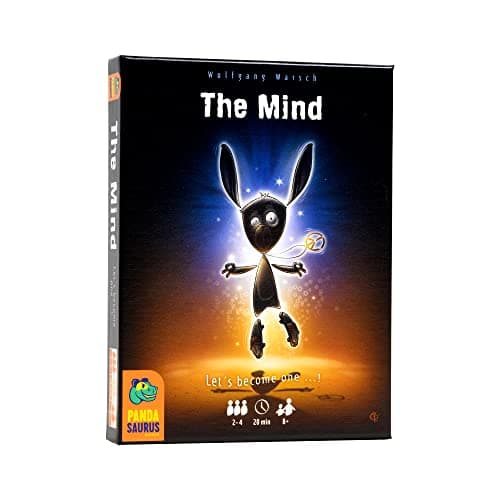
You play numbered cards in ascending order without speaking, and somehow it works. Fifteen minutes, 2 to 4 players, ages 8+. It is the strangest thing on this site and the one people remember.
#ad Price as of October 15, 2026, from Amazon. Prices change. How we make money.
What it actually is
A cooperative card game with essentially one rule: play your cards low to high, as a group, with no communication of any kind.
What the publisher states
| Figure | Value | Source |
|---|---|---|
| Play time | 15 Minutes | Pandasaurus Games, published product page |
| Players | 2-4 | Pandasaurus Games, published product page |
| Age | 8+ | Pandasaurus Games, published product page |
Read from the publisher’s own page. Where a publisher does not state a figure, there is no row for it here.
What is good about it
- The shortest explanation of any game here, by a distance
- Fifteen minutes and a very small box
- Produces a genuinely odd shared experience that people describe to other people
What is not
- Some players simply do not click with it and find it pointless
- Caps at four
- Slight - it is a deck of numbered cards and nothing else
Who should skip it
Skip it for someone who wants to see what they are buying. Unwrapped, The Mind looks like a deck of numbers, because it is.
How it scored as a gift
- Easy to explain9.8
- Works for non-gamers8.4
- Group size range6.8
- Repeat plays7.4
- Feels like a gift6.4
Gift fit 7.6 / 10. That is our editorial judgment of how safe and well-aimed this is as a present, read off the published specifications - not a verdict on how good the game is, and not a test result. It is deliberately not marked up as a rating in this page’s structured data. How we pick.
How these were picked
We have not played these games and we do not pretend to have. What we did was read each publisher’s own page, take their stated player count, playing time and age band, check that every pick genuinely fits the constraint in this page’s title, confirm it is still being sold, and pull a live price rather than a remembered one. Every figure here names the publisher it came from, so you can check it yourself in about a minute.
How we pick sets out the full method, including what would change a ranking.
Questions people ask
+−How does The Mind work?
Pandasaurus describes it as working together to play cards in ascending order, with no speaking or communication allowed. Everyone holds numbered cards, and the table has to play them all in sequence using nothing but timing.
+−Can you talk during The Mind?
No - the publisher states that no verbal or non-verbal communication is allowed between players. That restriction is the entire design, and a table that ignores it is not really playing the game.
+−How many players is The Mind for?
Pandasaurus states 2-4 players. Four is the top of the range and the hardest version, because there are more unseen cards between yours and the next one.
+−Is The Mind a good gift?
As part of a bigger present, yes - it is cheap, tiny and memorable. As a main present it looks like what it is, a deck of numbered cards, and the person opening it will not understand why until they play it.
+−What age is The Mind suitable for?
Pandasaurus states 8+. There is no reading and no arithmetic beyond ordering numbers, so the floor is about patience and reading a table’s mood rather than about skill.