Game page
Jaipur
Two traders, one market, and a decision every turn about whether to sell now or hold for more. It explains in about ninety seconds and is still interesting on the fiftieth play.
By Scooter M. · Published · Last updated
How this page is funded: the buy links below are affiliate links. If you buy through one, we earn a commission at no extra cost to you. It does not change the order of the picks or what we say about them. Full disclosure.
Games we claim to have play-tested: 0. Every gift guide in this category implies a shelf of played games behind it. We do not have one, and we would rather say so. What we do instead is on this page: the publisher’s own player count, playing time and age band for every pick, cited to the publisher; a live price rather than a remembered one; and a plain answer on who should skip each game.
The short answer
Jaipur is a two-player card game about trading goods. Space Cowboys states 2 players, ages 10+, 30 minutes. You take cards from a shared market or sell what you are holding for rupees, and the merchant who is richest at the end of a round takes a Seal of Excellence - first to two Seals wins.
What it actually is
Five cards sit face up between the two players. That is the market. On your turn you do one of two things: take from the market, or sell from your hand.
Selling is where the game lives. Space Cowboys’ own description puts it simply - you collect goods at the market and sell them for rupees, and a sale of three or more cards at once earns bonus tokens on top. So every turn is the same question in a different shape: sell the two cards you are holding now, or wait for a third and take the bonus - while your opponent is looking at exactly the same market you are.
The camels are the part people ask about. They are not goods you sell; the publisher describes them as trade tokens for acquiring multiple market goods. Take camels and you can swap several of them at once for several goods, which is how you take three cards in a turn instead of one. There is also a bonus at the end of each round for whoever holds the most camels, so they are never wasted.
| Figure | Value | Source |
|---|---|---|
| Players | 2 | Space Cowboys, published game page |
| Age | 10+ | Space Cowboys, published game page |
| Playing time | 30 min | Space Cowboys, published game page |
The structure is why it holds up
A game is not one sitting of thirty minutes - it is a best-of-three. Space Cowboys states that at the end of each round the wealthiest merchant wins that round and takes a Seal of Excellence, and that the first player to collect two Seals wins the game overall.
That shape does something most short games do not: it gives a session a beginning and an end. A single round is quick enough that losing it does not matter, and the person who lost the first round starts the second one knowing exactly what their opponent was collecting. Very few games this cheap have that much structure.
Why it is the two-player game we recommend most
Across this site, Jaipur appears on more two-player lists than anything else we cover, and the reason is the gap between how easy it is to teach and how long it stays interesting. The turn is take or sell. There is no board, no setup beyond dealing five cards, and nothing on the cards to read.
Compare that with the other things we recommend for two. 7 Wonders Duel (Repos Production: 2 players, 10+, 30 minutes) is the better game and takes three times as long to explain. Patchwork (Lookout Games: 2 players, 8+) is a puzzle rather than a fight. Hive (Gen42: 2 players, 9+, 20 minutes) is closer to chess. Jaipur is the one you can hand to two people who have never played a modern board game and expect them to be playing properly inside five minutes.
What is good about it
- Ninety seconds of explanation, then a real game - the shortest teach of anything we recommend for two players
- Every turn is a genuine decision: sell the two you are holding, or wait for the third card and the bonus that comes with it
- Best-of-three rounds give a session a natural shape rather than an arbitrary stop
- Small box, no board, few components - it works as a travel game without being a lesser one
- Camels mean a bad market is never a wasted turn; there is always something useful to take
What is not
- Two players only. Space Cowboys states 2 and there is no variant in the box - if a third person arrives, it goes away
- The camel rule confuses almost everybody exactly once, usually in the first five minutes
- Card quality is ordinary rather than luxurious, which is noticeable if you shuffle a lot
- There is luck in what the market offers, and a bad run of cards at the wrong moment can decide a round
- It is not a game with a story or a theme you sink into - the setting is a coat of paint on a clean piece of mathematics
Who should skip it
Any household that is usually three or more. This is the single reason not to buy Jaipur, and it is not a small one. There is no three-player mode and nothing about the design stretches to one. If your table fluctuates, Sushi Go! (Gamewright: 2-5 players, 8+, 15 minutes) does a similar job at a wider count, and our two-player page flags which of its picks also work with more.
Anybody who wants a game with a world in it. Jaipur is abstract underneath - the goods could be anything. Players who want theme and story will find it dry, and Wingspan or Ticket to Ride is the better present for them.
Children much below the stated ten. The arithmetic is simple, but holding back a sale to make it bigger later is a real piece of patience, and that is the part younger players find hard rather than the rules.
How it compares to the alternatives
Against 7 Wonders Duel, Jaipur is the one that gets played on a weeknight and Duel is the one for an evening you planned. Both state 30 minutes; only one of them can be taught during the first hand.
Against Splendor Duel (Space Cowboys: 2 players, 10+, 30 minutes), which shares Jaipur’s publisher and its length, Jaipur is simpler and more immediate while Splendor Duel has more to think about. We put those two head to head on 7 Wonders Duel vs Splendor Duel if the choice is between the heavier pair.
Against a deck of ordinary playing cards, which is the real competition for a game this size: Jaipur costs what a couple of coffees cost and gives two people something to do that neither of them already knows the shape of. Our two-player card games list has the rest of the field.
What it costs
Jaipur sits at the card-game end of the price range rather than the board-game end, which makes it one of the easiest presents to justify on this site: it is cheaper than most of what we recommend and scores higher with us than nearly all of it. We never print a remembered price anywhere - the button above carries a live figure when we hold one and says so plainly when we do not. Our picks under $30 put it in context.
What we would buy for this
Chosen from the same registry as our roundups, on the publisher's own figures and a live price.
Jaipur
Space Cowboys · Two people who want something quick and repeatable
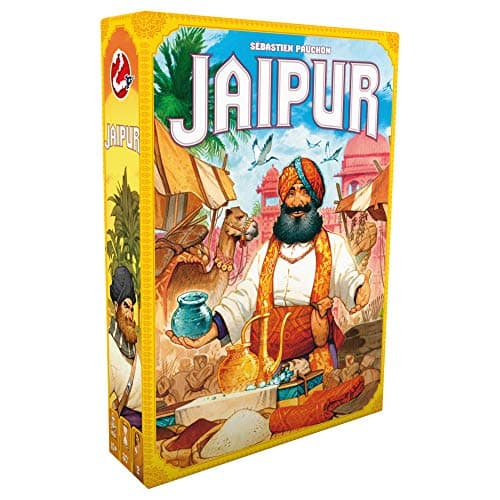
Two traders, a market of goods cards, and a decision every turn about whether to sell now or hold for more. Thirty minutes by the publisher's clock and about ninety seconds to explain.
#ad Price as of October 15, 2026, from Amazon. Prices change. How we make money.
What it actually is
A two-player card game about buying and selling goods. Selling more of the same thing at once pays better, but the price of everything drops as it is sold.
What the publisher states
| Figure | Value | Source |
|---|---|---|
| Players | 2 | Space Cowboys, published game page |
| Age | 10+ | Space Cowboys, published game page |
| Length | 30 min | Space Cowboys, published game page |
Read from the publisher’s own page. Where a publisher does not state a figure, there is no row for it here.
What is good about it
- One of the easiest good two-player games to teach - sell or take, that is the turn
- Best of three rounds, so a session has a natural shape
- Small box, so it works as a travel game as well as a home one
What is not
- Two players only
- The camel rule confuses people exactly once, and then never again
- Card quality is the ordinary sort, not the luxury sort
Who should skip it
Skip it for a group. Jaipur has no variant above two players and nothing about it stretches.
How it scored as a gift
- Easy to explain9.4
- Works for non-gamers9.2
- Group size range4.0
- Repeat plays9.2
- Feels like a gift8.2
Gift fit 9.0 / 10. That is our editorial judgment of how safe and well-aimed this is as a present, read off the published specifications - not a verdict on how good the game is, and not a test result. It is deliberately not marked up as a rating in this page’s structured data. How we pick.
How these were picked
We have not played these games and we do not pretend to have. What we did was read each publisher’s own page, take their stated player count, playing time and age band, check that every pick genuinely fits the constraint in this page’s title, confirm it is still being sold, and pull a live price rather than a remembered one. Every figure here names the publisher it came from, so you can check it yourself in about a minute.
How we pick sets out the full method, including what would change a ranking.
Questions people ask
+−How many players is Jaipur for?
Two, and only two. Space Cowboys states 2 players, and there is no three-player or four-player variant in the box. It is the main reason to buy something else if your household is usually bigger.
+−How long does a game of Jaipur take?
Space Cowboys states 30 minutes. That covers a best-of-three: the wealthiest merchant at the end of each round takes a Seal of Excellence, and the first player to collect two Seals wins the game overall.
+−What age is Jaipur suitable for?
Space Cowboys states 10+. The arithmetic is well within a younger child, but holding a sale back to make it larger later is a real test of patience, and that is the part that decides whether a younger player enjoys it. Publisher-stated ages for everything we cover are on our age guide.
+−How do camels work in Jaipur?
They are not goods you sell. The publisher describes them as trade tokens used when acquiring multiple market goods - you swap camels for several cards at once, which is how you take more than one card in a turn. There is also a bonus at the end of each round for holding the most camels.
+−Is Jaipur a good gift for a couple?
It is the one we recommend most often for exactly two people: 30 minutes by the publisher’s clock, almost nothing to explain, and short enough to play twice in an evening. More options for two are on our couples page.